Remove Watermark From Image Online: What Works, What Breaks, and a Cleaner Alternative
What really works to remove watermarks online—and where tools fail. Try selection + cleanup passes, keep edits minimal, and stick to licensed assets.
 Sierra CappelenDecember 12, 2025
Remove Watermark From Image Online: What Works, What Breaks, and a Cleaner Alternative
If you sell on Amazon or Etsy, post product shots on Instagram, or prepare brand decks, you’ve likely met the same pain: you have the perfect photo, but the watermark has to go before it’s usable. You try cropping. You try blurring. You try cloning, and the texture still looks off. Meanwhile, deadlines don’t wait.
Good news: modern AI can remove many watermarks in seconds—especially linear logos across simple textures. But it’s not magic. Knowing what inpainting does, where it fails, and how to make two quick cleanup passes is the difference between “almost right” and “no one will ever notice.” If you want a fast start, an online watermark remover gives you a simple way to test your image with zero setup.
Trend note: generative inpainting has improved rapidly, yet still struggles on faces and text-heavy areas. And with ecommerce guidelines leaning toward clean, distraction-free imagery, learning a reliable, ethical workflow pays for itself.
When you should remove watermarks—and when you absolutely shouldn’t
- It’s okay to remove a watermark from an image you own or are licensed to edit (e.g., your brand’s product shots, your client’s assets, or stock you’ve paid for that allows modification).
- It’s not okay to strip a watermark from images you don’t have rights to use. Many platforms enforce licensing and attribution; misuse can lead to takedowns or legal issues.
Short rule of thumb: always confirm licensing. Use watermark removal to polish your own creative or licensed assets, not to bypass someone else’s copyright or branding.
How watermark removal works: inpainting, diffusion, and texture synthesis
Most “remove watermark from image” tools draw on inpainting. The software predicts what should appear under the watermark by sampling surrounding pixels and generating a plausible fill. Newer diffusion models are better at:
- Continuing textures (wood, fabric, brushed metal)
- Restoring simple edges and gradients
- Filling uniform backgrounds consistently
But they’re still approximations. On complex regions—like type, faces, glass reflections, or dense patterns—the model must invent detail. That’s where artifacts creep in: repeated texture tiles, smeared edges, or wavy lines that give the edit away.
Understanding limits helps you choose the right approach and set expectations before you click “Download.”
Quality limits: busy patterns, faces, text edges, and gradient logos
Expect the strongest results when:
- The watermark sits on uniform or lightly varied textures.
- The mark is semi-transparent and not intertwined with detailed content.
- The area under the logo is easy to infer from nearby pixels.
Expect compromises when:
- The watermark crosses faces, small text, or intricate logos.
- The background has strong structure (checker patterns, grilles, repeating seams).
- The mark runs through gradients with lighting transitions.
Tricks that help:
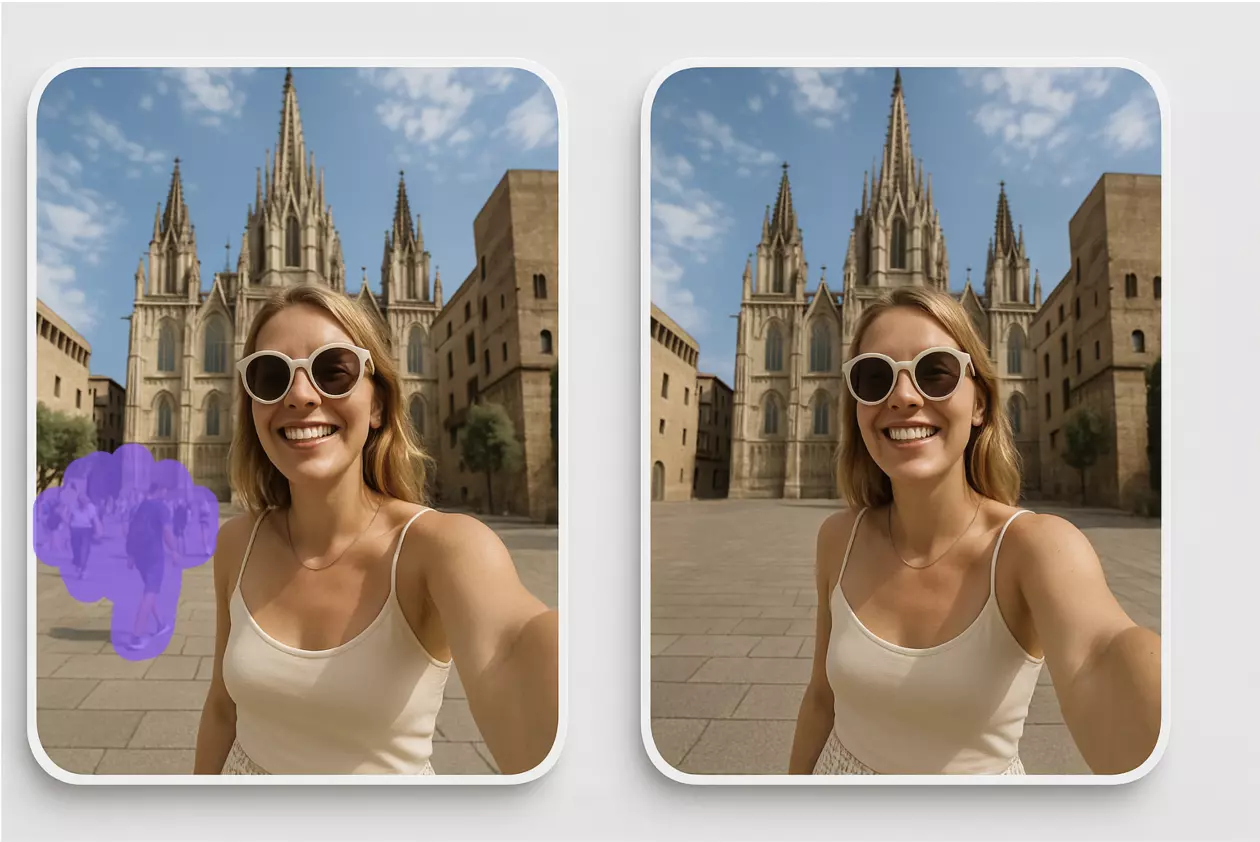
- Shrink your selection to the watermark edges and feather slightly, so the tool blends naturally.
- Use two passes: first to clear the mark, second to patch any repeating patterns.
(See image: side-by-side before/after showing a diagonal logo removed from a product photo, with a zoomed edge to verify texture continuity.)
Online vs desktop watermark remover tools: accuracy, privacy, and speed
Desktop software like Photoshop offers surgical control with healing, clone-stamp, and content-aware fill—powerful, but time-consuming and skill-heavy. Outsourcing can work for large batches, but adds coordination delays and revision loops.
Online tools are ideal when you need:
- Speed: one-off or batch edits without installing software.
- Low learning curve: usable by marketers, creators, or sellers, not just designers.
- Consistency: quick, repeatable edits across a set of product shots.
Privacy matters too. Many online editors emphasize secure handling and minimal data retention. Choose tools with clear policies and the option to download results immediately. For teams working at pace, online tools deliver the best balance of accuracy and turnaround—especially on routine removals.
Step-by-step: remove watermark online with selection and cleanup passes
Use this method when a watermark crosses a texture you want to preserve.
- Duplicate the image
- Always keep a backup. Work on a copy so you can A/B test the result.
- Make a tight selection
- Lasso or brush just over the watermark. Avoid grabbing large clean areas; smaller selections give more accurate fills.
- Feather by 1–3 px
- A soft edge helps the tool blend back into the original texture.
- First inpaint
- Run the removal once. Don’t aim for perfection yet; you’re clearing the bulk of the mark.
- Inspect for patterns or smudges
- Zoom to 200–300%. Look for repeated tiles, stretched fibers, or wobbly lines.
- Cleanup pass
- Re-select only the problem spots with an even tighter selection. Inpaint again to fix artifacts without disturbing the good areas.
- Final blend
- If needed, lightly retouch with a small healing brush to align grain and lighting.
(See image: selection mask around a diagonal watermark using soft feathering and two cleanup passes, demonstrating natural grain restoration.)
Using Pixflux.AI to remove watermarks in three steps—and refine the background
Pixflux.AI is built for quick, practical edits: remove logos and marks, clean backgrounds, enhance clarity, and even fix stray objects—all without a heavy learning curve. Here’s the simplest flow:
- Upload your image
- Let the AI remove the watermark
- Download the cleaned result
That’s it for most photos. For trickier cases, a slightly longer flow gives you more control:
- Open the Pixflux.AI tool page
- Upload your original image
- Choose the watermark removal option and run the AI
- Preview the result, then make a second cleanup pass on any small artifacts
- Download the final image
Beyond watermark removal, Pixflux.AI can also help the final image feel consistent with your storefront or campaign:
- Replace a busy background with a cleaner studio look for ecommerce guidelines.
- Enhance sharpness and contrast so the area under the old mark matches surrounding grain.
- Remove unwanted objects (like reflections or cables) that pull attention away from the subject.
- Batch‑process a set of product shots when you need a uniform look fast.
If you want to try this now, start with a single image and remove watermark from image, then use a cleanup pass for any fine artifacts.
(See image: the Pixflux.AI interface illustrating the upload → AI process → download preview with watermark removal.)
Advanced edits that look natural: feathering, multi-pass heals, and blending
- Feathering: a subtle 1–3 px feather hides hard borders and prevents “sticker edges.”
- Multi-pass heals: two or three small, localized inpaints beat one giant selection 9 times out of 10.
- Blend by structure: if the watermark crosses a line or seam, rebuild that seam last using a very thin selection that follows the line.
- Match grain: if the fill looks too smooth, lightly add noise or grain to match the camera texture.
- Avoid over-smoothing on faces: for portrait areas, consider a tiny brush and micro selections along features like the nose bridge, lips, and hair edges.
Safer workflows: use your own assets, templates, and batch edits
The cleanest, most scalable workflow is to avoid watermarks in the first place:
- Shoot or commission your own product photos.
- License stock with permissions that match your usage.
- Build reusable templates for backgrounds (brand colors, gradients, or simple surfaces).
When you do need cleanup, work at scale:
- Use batch editing to apply similar removals and background cleanups across a collection.
- Keep a simple checklist: duplicate → select → feather → inpaint → inspect → cleanup.
Pixflux.AI supports this style of work with quick uploads, fast previews, and multi-image handling so your output stays consistent across the line.
Case checks: before/after review for artifacts, repetition, and lighting
Before you publish or hand off to a client, verify the realism:
- Texture repetition: scan for repeating tiles, especially in fabric, floors, and brushed metal.
- Edge fidelity: confirm that straight edges remain straight and that text not targeted by the removal is still sharp.
- Lighting continuity: the filled area should match highlight rolloff and shadow softness.
- Color cast: ensure no subtle tint shift where the watermark lived.
- Print and mobile: zoom to 300% on desktop but also review at phone size; some artifacts only jump out in one context.
(See image: side-by-side before/after zoom crops showing texture continuity along a removed logo path.)
Legal and ethical notes: licensing, attribution, and publicity rights
- Only remove watermarks on images you own or have explicit permission to modify. This includes client assets with a license that allows edits.
- Don’t use watermark removal to bypass licensing, attribution requirements, or platform policies.
- Respect publicity rights: be mindful when editing images that include identifiable people, trademarks, or private property where permissions may apply.
AI online tools vs traditional software or outsourcing
- Time cost: AI online tools deliver results in seconds, perfect for campaign sprints or listing updates. Traditional desktop tools can match or exceed quality but take more hands-on time.
- Learning curve: marketers and creators can get pro-looking results without mastering advanced clone/stamp workflows.
- Batch efficiency: online tools make it easier to process a whole set consistently, ideal for multi-SKU catalogs.
- Collaboration: files are easy to share and review; anyone on the team can produce updates without waiting on a specialist.
- Quality ceiling: for complex composites or high-end retouching, a skilled editor in desktop software may still win. For everyday watermark removal and background cleanup, modern AI will hit the brief quickly and cleanly.
Pixflux.AI sits in the sweet spot: fast, approachable, and accurate on common tasks like removing watermarks, clearing or replacing backgrounds, removing unwanted objects, and enhancing product clarity.
Common pitfalls—and how to fix them fast
- The filled area looks too smooth: add a touch of grain or run a small, second inpaint pass with a tighter selection.
- A line or seam looks bent: reselect just the seam and run a thin, straight pass along it.
- Gradient banding after removal: make a small, feathered selection across the band and blend with a gentle heal; avoid heavy sharpening.
Quick FAQ
- Will AI remove every watermark perfectly?
- No. It performs best on simple textures; it’s less reliable on faces, small type, or complex patterns.
- Can I remove a watermark from an image I found online?
- Only if you have the rights to use and modify it. When in doubt, don’t.
- Is one pass enough?
- Often yes, but a short cleanup pass dramatically improves realism on tricky areas.
Conclusion and next steps
Watermark removal has matured from guesswork to a fast, repeatable step in a modern image workflow. By combining inpainting with smart selections, a light feather, and a quick cleanup pass, you’ll get natural results that hold up under zoom. For day-to-day needs—product images, social assets, client previews—Pixflux.AI makes the process simple and consistent, and can also refine backgrounds, remove distractions, and enhance clarity so your final looks polished.
Ready to try it on your own asset? Start with a single photo and remove watermark online in a few seconds, then use a quick cleanup pass for a perfect finish.