Remove Text from an Image Online: Browser-Only Fixes for Screenshots, Labels, and Listings
Need to clean text off screenshots or labels without software? Do it in your browser with Pixflux.AI—fast fixes, batch runs, and crisp exports for listings.
 Richard SullivanJanuary 23, 2026
Remove Text from an Image Online: Browser-Only Fixes for Screenshots, Labels, and Listings
Sellers move fast. You’re juggling supplier screenshots with annotations, size charts pasted over product photos, and listing images that need to be clean by end of day. Opening heavyweight desktop editors or booking a designer isn’t always an option—especially when you’re on a laptop between meetings or working from a warehouse floor.
Good news: by 2026, browser-based AI inpainting rivals desktop tools for speed and quality. If your goal is to remove text from an image online without installing software, modern “online text remover” workflows are now robust enough for everyday ecommerce. A practical place to start is an AI tool that lets you remove text from an image online in a few clicks, then export clean variants for Amazon, eBay, Etsy, TikTok Shop, or your own storefront.
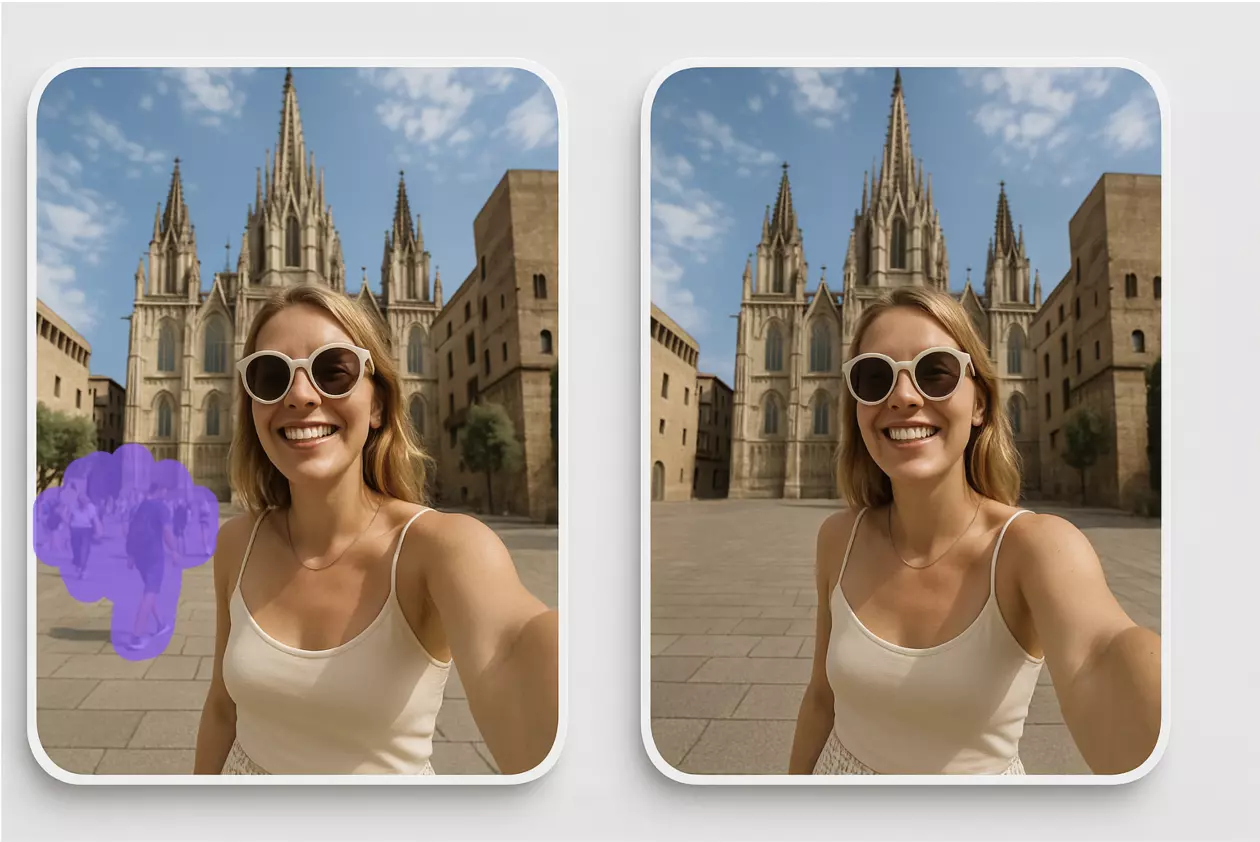
(See image: Pixflux.AI interface showing the three steps—upload image, AI processing preview, and download result.)
Why sellers need browser‑only text removal
- Supplier screenshots are often full of rectangles, arrows, and notes—useful for sourcing, painful for listings.
- Size charts and temporary promos sometimes sit on top of otherwise perfect images you want to reuse.
- Marketplaces are tightening image policies, rewarding distraction‑free photos that load fast and look trustworthy.
- Teams and freelancers mix Mac/Windows/Chromebook. A browser‑only tool keeps everyone aligned with zero installs.
Bottom line: quick, consistent cleanup means faster listing cycles and fewer image rejections.
How online text removal works (plain‑English)
- Inpainting: You select the unwanted text; the AI predicts what should be behind it by reading surrounding patterns, edges, and textures.
- Diffusion: For larger areas or complex textures (fabric, wood grain), diffusion models synthesize plausible background detail.
- Content‑aware fill: Classic image logic that samples nearby pixels to “fill the gap,” now enhanced with AI for sharper continuity.
Modern tools blend these methods automatically. Your job is simple: mask the text cleanly, preview, and refine if needed.
What to look for in an online text remover
- Quality: Natural texture restoration without smudges or repeating patterns.
- Speed: Results in seconds; minimal lag for multiple images.
- Security: Browser processing with privacy controls and clear retention policies.
- Limits: File size caps, supported formats (PNG, JPEG, WebP), and batch handling.
- Export options: Transparent backgrounds (if needed), WebP for speed, and PNG/JPEG for marketplace compatibility.
Remove text from an image online with Pixflux.AI: upload, process, download
Use this fast three‑step flow to clean screenshots, labels, and listing photos directly in your browser:
- Upload your image
- Drag in your supplier screenshot, listing photo, or size chart composite.
- Let the AI remove the text
- Brush over the text or select the text region; the Pixflux.AI object remover fills it with realistic background detail.
- Download the cleaned result
- Export as PNG, JPEG, or WebP based on where you’ll publish.
Tip: If you’re trying this the first time, open the online text remover tool in a new tab so you can follow along as you read.
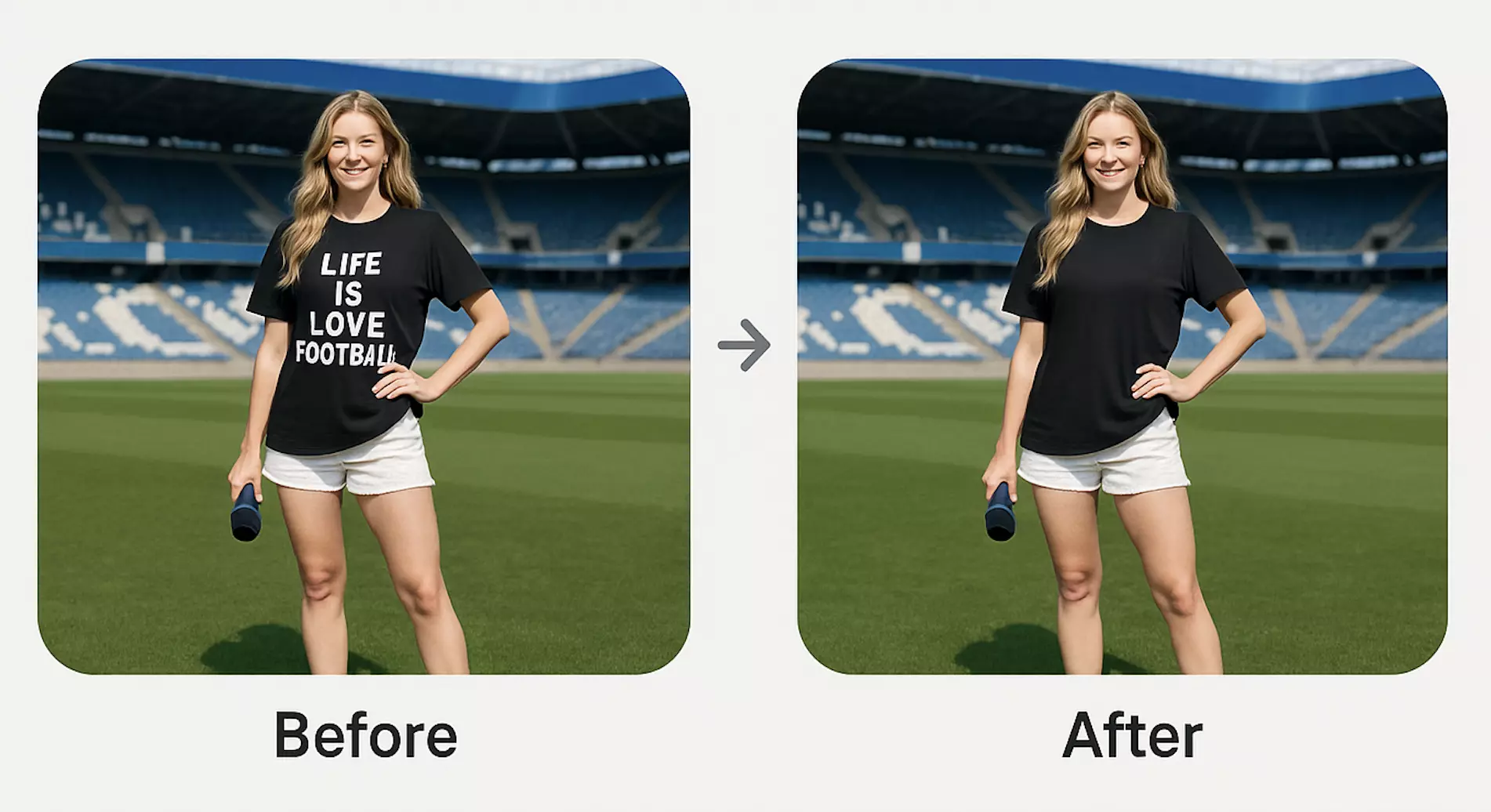
(See image: Before‑and‑after comparison of a supplier screenshot with annotations removed using an AI object remover.)
Step‑by‑step: clean supplier screenshots and size charts without artifacts
For complex overlays (e.g., bold captions across fabric or gradients), use a slightly more deliberate five‑step pass:
- Open the Pixflux.AI tool page
- Load the image that contains the unwanted text or label.
- Upload your original file
- Higher resolution gives the AI more context to rebuild textures.
- Choose the object/text removal tool and run the AI
- Mask the text precisely. Cover the full stroke of letters plus 2–5 px margin to help the model read edges.
- Preview and micro‑refine
- If you see minor seams, re‑mask a slightly larger area or run a second pass. For low‑contrast areas, a tighter mask often improves texture continuity.
- Download your clean image
- Save to WebP for your storefront for faster page speed, or PNG/JPEG for marketplace uploads.
(See image: Product listing photo where a size chart text overlay is erased and the background texture is restored.)
Pro tip: When text sits on top of repetitive patterns (e.g., plaid cloth), two smaller passes can look more natural than one oversized mask. On gradients, expand the mask a bit so the AI can re‑synthesize a smooth blend.
Batch cleanup for multiple listing images with the Pixflux.AI object remover
When you have a folder of supplier images and captions to clear, batch handling saves real time:
- Upload multiple files and process them in one go.
- Use consistent masking across similar images (e.g., same corner banner or size chart placement).
- Download your results together to keep your listing workflow moving.
This is especially helpful for seasonal catalog updates or when onboarding new SKUs from the same vendor.
When to remove text vs. replace or regenerate the background
Most of the time, pure text removal is enough. However, consider these alternatives for an even cleaner result:
- Replace the background if the original is busy or inconsistent. A neutral backdrop helps marketplace compliance and conversion.
- Generate a fresh background from scratch if the text cuts through complex edges (e.g., hair, translucent packaging). Regenerating avoids micro‑artifacts and yields a polished hero image.
- Remove text and enhance the image in the same session: denoise, sharpen, and adjust contrast to restore clarity after cleanup.
Pixflux.AI supports these adjacent use cases—background removal/modification/generation, object removal, and image enhancement—so you can finish the entire cleanup in one browser session.
Quality control: edges, textures, and export settings
- Check edges at 100% zoom: Look for halos where text overlapped product contours; redo small masks if needed.
- Texture continuity: On wood, fabric, and metal, ensure grain or weave doesn’t abruptly repeat.
- Shadows and reflections: If text sat over soft shadows, re‑mask slightly larger to let the AI rebuild a believable gradient.
Export choices:
- PNG for crisp graphics and transparent backgrounds.
- JPEG for general marketplace uploads at 80–90% quality.
- WebP for storefronts; it’s smaller, faster, and—thanks to smarter compression—visually lossless for most product photos.
Compliance and ethics: watermarks, attributions, and marketplace policies
- Only remove text or watermarks from images you own or have permission to edit.
- Do not use watermark removal to bypass licensing, creator credit, or platform rules.
- Many marketplaces require truthful, non‑misleading imagery. If text communicates safety, size, or legal info, verify you can remove it without violating policies.
A simple rule of thumb: if the text signifies ownership or required disclosure, get the right authorization before editing.
Troubleshooting tough cases
- Complex patterns (plaid, stripes, repeating tiles): Mask in smaller sections, following the pattern direction. Two passes often look more natural.
- Gradients and soft light: Expand your mask beyond the text by a few pixels so the AI can rebuild a smooth falloff.
- Low‑resolution files: Upscale or enhance first to give the AI more detail to work with. After removal, downsize to your target dimensions to hide any micro‑artifacts.
- Semi‑transparent overlays: Include the full overlay area in your mask (not just the letters) to avoid faint residual shapes.
- Text crossing hard edges: Run separate masks for each side of the edge (background vs product) so the model can respect contours.
AI online tools vs. traditional methods
- Time cost: Browser tools deliver results in seconds. Desktop editors can be great but require opening apps, managing layers, and saving variants—slower for quick fixes.
- Learning curve: AI inpainting is mostly paint‑and‑preview. Traditional content‑aware workflows demand more manual finesse.
- Batch efficiency: Online workflows handle multiple images without preset configuration, ideal for sellers who process recurring supplier layouts.
- Team fit: A link and a laptop is enough. No installs, versions, or OS quirks to slow down remote teams and freelancers.
For many sellers, Pixflux.AI becomes the first pass for cleanup and enhancement; only edge cases need a manual deep dive.
Try it now: quick guide in your browser
If you’re in a rush, here’s the one‑minute checklist:
- Open the online text remover tool.
- Upload your image, mask the text, preview, and re‑mask if needed.
- Export to WebP or JPEG, drop into your listing, and ship.
FAQ: Online text remover basics, limits, file types, privacy, and best practices
Can I remove text from an image online without installing software?
Yes—modern browser tools can cleanly erase text in seconds. AI inpainting and diffusion can reconstruct realistic textures behind captions, labels, or annotations. For best results, start with the highest‑resolution image you have and mask slightly beyond the text edges.
Will removing text leave visible smudges or patterns?
With a good mask and one or two passes, results are typically seamless. Artifacts usually come from tight masks or complex patterns. Expand your selection a few pixels, zoom to 100% to check edges, and re‑run the removal on small sections to improve texture continuity.
What file types should I upload and export?
Upload PNG or high‑quality JPEG; export PNG, JPEG, or WebP based on your channel. PNG preserves transparency and crisp edges, JPEG keeps file sizes small for marketplaces, and WebP gives excellent page speed for storefronts with minimal visible quality loss.
Is batch removal supported for multiple listing images?
Yes, you can handle multiple images in one session for faster workflows. Batch cleanup is useful when supplier templates repeat text placement. Keep your masks consistent across similar shots to speed up processing and maintain uniform results.
Is it legal to remove watermarks or attributions?
Only if you own the image or have explicit permission to edit it. Watermarks indicate ownership or licensing. Use text and watermark removal responsibly—don’t remove marks to circumvent copyrights or marketplace rules. When in doubt, obtain authorization or use licensed, watermark‑free assets.
How does this compare to desktop editors like Photoshop?
For day‑to‑day cleanup, browser AI matches or beats desktop speed with less manual work. Desktop tools still excel for pixel‑perfect retouching and complex composites, but sellers often prefer browser workflows for quick, repeatable edits and batch processing on any laptop.
Does the tool work for screenshots with UI elements and arrows?
Yes, annotations and shapes can be removed along with text. Mask over the entire annotation (not just the text) so the AI can rebuild the underlying UI or background. For clean results, use small, precise masks and run multiple passes if elements overlap.
Will my images be secure when processed online?
Reputable tools provide privacy controls and transparent retention policies. If you handle sensitive assets, review the tool’s privacy page and delete files after export. Working entirely in the browser reduces the need for file sharing across devices.
Conclusion and next steps
Clean visuals convert. With marketplaces favoring distraction‑free images and WebP improving storefront speed, a simple browser workflow can replace hours of manual edits. Pixflux.AI gives sellers a practical way to remove labels, captions, and watermarks you’re authorized to edit—plus options to enhance or refresh backgrounds for a polished finish.
Ready to tidy up your catalog? Open the tool and erase text from images in browser now—upload, process, and publish in minutes.