AR Try On Ready Images Create Transparent Background Assets Fast
Make AR try-ons look real: cut perfect transparent backgrounds, keep soft shadows, and export fast—plus batch with Pixflux.AI.
 Emily CremerJanuary 10, 2026
AR Try-On Ready Images: Create Transparent Background Assets Fast
Shoppers expect virtual try-on to feel instant and real: products should snap into place, sit naturally on skin or surfaces, and load without delay. Yet most teams wrestle with the same bottlenecks—manual cutouts that leave halos, inconsistent shadows that float, and heavy files that stall on mobile. The result is a cart-killing mismatch between product promise and on-screen execution.
In 2026, retailers have largely standardized alpha-based PNG pipelines for AR, and edge-aware AI matting now removes color spill even in hair and fur. If you’re still spending hours with the pen tool, you’re falling behind. An AI-first workflow can deliver clean, AR-ready transparent PNGs in minutes—without sacrificing fidelity. For a quick win, try a tool that can produce a clean transparent background cutout with preserved soft shadows, ready for virtual try-on.
Why transparent backgrounds matter for AR try-on realism
Transparent backgrounds (alpha channels) make AR overlays behave as if they were native to the scene. They enable:
- Seamless compositing against live camera feeds without rectangular edges or matte lines.
- Accurate occlusion handling, so semi-transparent areas like lace, hair, or glass read correctly.
- Grounded presentation with soft, semi-transparent shadows, helping objects sit on skin, tables, or floors instead of floating.
- Reusable, channel-aware assets that work across web AR, mobile apps, and social platforms without rework.
For virtual shopping and try-on, the alpha channel is not a cosmetic choice; it’s the basis for realism and credible scale, lighting, and contact.
Choose the right format: PNG with alpha, profiles, and alpha mode
For most AR try-on image assets, PNG with alpha (often called PNG‑24 with transparency) is the safest default. These settings keep your pipeline predictable:
- Color space: sRGB IEC61966-2.1 is the most cross-platform-friendly for browsers and mobile. Avoid wide-gamut profiles unless your app fully manages color.
- Alpha mode: Use straight (unpremultiplied) alpha unless your rendering engine requires premultiplied alpha. Straight alpha avoids edge darkening when composited over varying backgrounds.
- Bit depth: 8‑bit per channel is enough in most retail cases; 16‑bit is overkill for web AR and bloats file size.
- Compression: Lossless PNG with perceptual quantization can cut size while maintaining clean edges; validate against banding in gradients and semi-transparent shadows.
Note: Some engines handle premultiplied alpha better for real-time blending. If you must premultiply, ensure your pipeline uses a neutral matte color (typically linearized black) to avoid edge tinting.
Edge fidelity matters: halos, anti-aliasing, and fine detail
Edges are where realism lives. Common cutout artifacts break immersion:
- Halos from a white or colored matte
- Jagged edges from insufficient anti-aliasing
- Green spill from studio backdrops
- Lost texture in hair, fur, or frayed textiles
Use an edge-aware matting approach that handles soft transitions and semi-transparent strands. AI-driven cutouts now reliably estimate alpha for complex boundaries, reducing manual cleanup. Prioritize “edge refinement,” feather only where real physics would soften the boundary, and defringe by removing matte contamination.
Tip: Zoom to 200–400% and pan around hairlines, glass rims, and perforations. Look for color fringing on high-contrast backgrounds—a sign that your matte still carries the original backdrop.
(See image: close-up crops showing original vs anti-aliased cutout, highlighting halo removal and fine hair detail on a transparent background.)
Grounded realism: preserve soft shadows and subtle reflections
Floating products kill trust. A grounded, consistent shadow gives scale and context:
- Keep a soft, contact shadow beneath shoes, bottles, and jewelry. Semi-transparent pixels in PNG emulate real softness.
- Avoid hard, directionally confusing shadows. If your AR scene will simulate lighting, keep your baked-in shadow minimal and neutral to avoid double shadows.
- Reflections on glossy products should be subtle; high-contrast mirror effects tend to look fake once composited against live camera.
Workflow suggestion:
- Isolate the product on a transparent canvas.
- Create a separate shadow layer (soft, neutral gray) beneath the object; blur until edges match a realistic falloff.
- Reduce opacity (15–35%) for a natural grounded look, balancing visibility against different end backgrounds.
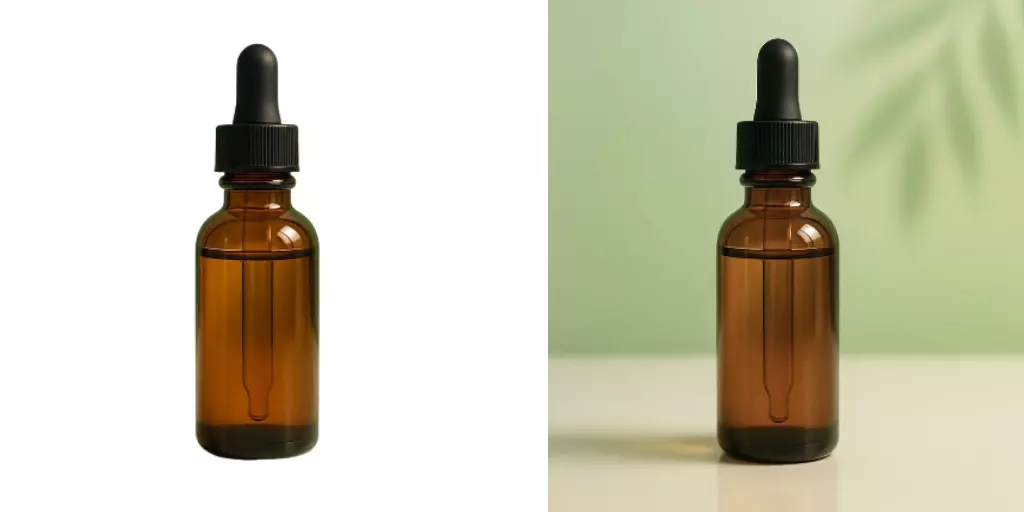
(See image: before/after comparison of a product photo with background removed while preserving a soft, grounded shadow on a transparent canvas.)
Step-by-step export in a desktop editor
If you prefer a desktop editor, this quick export checklist helps you avoid common pitfalls:
- Open your source image in a color-managed workspace set to sRGB.
- Create a selection or mask around the product, then refine edges with feathering only where needed (e.g., hair, fabric fringes).
- Remove the background to reveal transparency; inspect edges at 200% for halos and matte colors.
- Add a soft, neutral shadow layer below the product; blur to match object scale and presumed distance from the surface.
- Clean minor color spills using defringe or desaturate along the edge by 1–2 px.
- Ensure straight alpha in the final asset unless your engine requires premultiplied.
- Flatten visible layers while preserving transparency; don’t bake a colored matte.
- Export as PNG with alpha, sRGB profile embedded, and lossless compression. Target <4 MB per asset.
- Validate in your AR viewer on a dark and a light background to catch residual halos.
Use Pixflux.AI to create transparent backgrounds fast
When you need results at scale and don’t have time for manual masks, an AI-first flow yields production-grade assets:
- Upload the original image.
- Let the AI process the cutout and refine edges automatically, preserving soft details and consistent shadows.
- Download your transparent PNG background cutout and review on a dark/light checker to confirm alpha quality.
With Pixflux.AI, you can preview live cutouts, then nudge edges or shadows if needed before exporting. The tool is optimized for AR try-on assets where “edge refinement” and “consistent shadows” are critical for realism.
(See image: Pixflux.AI interface showing the 3-step flow—upload, AI process, download—with a live cutout preview.)
Advanced 5-step pass if you want more control:
- Open Pixflux.AI.
- Upload your source image(s).
- Choose background remove; optionally toggle edge smoothing and keep soft shadow.
- Preview, then fine-tune fringe cleanup around hair, glass, or mesh.
- Download PNGs with alpha and place into your AR pipeline.
Batch catalogs with Pixflux.AI for consistent edges, shadows, and naming
Most virtual shopping teams need repeatable quality across hundreds of SKUs. Pixflux.AI supports batch uploads so you can:
- Process entire collections in one go, ensuring uniform cutout rules and shadow handling.
- Apply consistent edge refinement settings so products from different photoshoots look cohesive in AR.
- Export with standardized naming conventions to match your asset library rules.
Consistency matters: small variations in shadow opacity or cutout softness can create a disjointed AR experience when users swipe across a catalog.
Quality checks and metrics to trust your assets
Before shipping to production, audit your assets with a few quick tests:
- Edge variance: Sample alpha around a few critical areas and compare softness; large swings across products indicate inconsistent settings.
- Matte lines: Place assets over pure white, pure black, and a saturated background to reveal hidden halos or color spill.
- Pixel inspection: Zoom in to 400% and scan hairlines, glass edges, lace, and perforations for jaggies or semi-transparent holes.
- AR anchoring tests: Load assets into a staging viewer and test on varied surfaces; confirm shadows read naturally and scale feels right.
A short checklist saves costly revisions once your AR experience is live.
Performance tuning for AR: size, compression, and speed
Performance is conversion. Keep assets fast and lightweight without compromising quality:
- Dimensions: Match expected on-screen size; avoid exporting massive 4000 px assets if the render target is 1080–1440 px.
- File size: Keep PNG with alpha under 4 MB; many teams aim for 1–2 MB where possible.
- Compression: Use PNG quantization that preserves semi-transparent edges; test for banding in shadows.
- Lazy loading: Prioritize hero SKUs; defer alternates until interaction.
- Variant strategy: For ultra-high detail (e.g., hair, fine chains), hold a high-fidelity master and generate a web-optimized version for mobile.
Compliance and rights: watermarks, logos, and background licensing
Only process images you own or are licensed to use. If you remove watermarks, logos, or branded backgrounds, ensure you have the rights to do so. AI-powered cleanup should never be used to circumvent copyright or platform rules.
If needed, use Pixflux.AI to safely remove in-frame marks you control—like your own studio logo or date stamp—and then finalize the alpha cutout for AR. Always maintain a clear audit trail for asset provenance.
Troubleshooting common issues
- Jagged edges: Increase edge smoothing slightly and ensure anti-aliasing is enabled. Re-check that your export kept straight alpha.
- Color fringing: Use defringe along the edge or neutralize spill by desaturating edge pixels; re-matte if the original background color bleeds.
- Missing shadows: Add a soft, elliptical contact shadow beneath the object at low opacity; confirm it’s semi-transparent and not clipped.
- Semi‑transparent holes: Inspect lace, mesh, or hair clumps; re-run an edge-aware refine pass to recover detail, then hand-restore small areas with a soft brush on the alpha.
AI tools vs traditional software and outsourcing
- Time cost: Manual pen-tool masking can take 15–45 minutes per image; AI cutouts often deliver in seconds, even for complex textures.
- Learning curve: Pro-grade desktop editors are powerful but steep. AI background tools offer production results with near-zero setup.
- Batch efficiency: Human workflows struggle at catalog scale; AI batch processing keeps edges and shadows consistent across hundreds of SKUs.
- Cross-team alignment: A standardized AI pipeline produces repeatable, spec-compliant assets that creative, ecom, and AR teams can share without rework.
Pixflux.AI brings these advantages together for product imagery where transparent backgrounds, edge refinement, and consistent shadows are non-negotiable.
FAQ: Transparent background best practices for AR try-on
What file format should I use for AR try-on images?
Use PNG with alpha (straight/unpremultiplied) in sRGB for broad compatibility. PNG preserves semi-transparent edges and soft shadows better than JPEG and avoids compression artifacts around hair, glass, and lace. Keep assets under 4 MB to maintain fast mobile performance.
How do I prevent halos and color fringing on edges?
Refine edges and remove matte contamination before export. Check your cutout on white, black, and saturated backgrounds to expose residual halos. Use edge-aware AI matting or a defringe pass to neutralize spill from the original backdrop, especially common with green screens and overexposed studios.
Can I keep soft shadows on a transparent background?
Yes—bake a subtle, semi-transparent shadow beneath the product in the PNG. Use a neutral gray, apply a Gaussian blur to match a realistic falloff, and reduce opacity until it reads as contact without overwhelming. This improves grounding while remaining flexible across different AR scenes.
What dimensions and file sizes work best for mobile AR?
Aim for the smallest size that maintains edge fidelity, generally under 4 MB. Match resolution to target render size (often 1080–1440 px for mobile). Use PNG quantization carefully to reduce weight while preserving soft edges and semi-transparent details.
How do I batch a catalog without inconsistent edges and shadows?
Use a consistent preset for edge refinement and shadow strength across all images. AI batch processing helps standardize results, so different photoshoots don’t produce visibly different cutout softness or shadow opacity. Review a representative sample before exporting the full set.
Is it okay to remove watermarks or logos before creating a transparent background?
Only remove marks you own or are licensed to modify. If you control the watermark (e.g., your studio’s), remove it prior to export so edges remain clean. Never use watermark removal to bypass third-party rights or platform policies.
Should I export with straight or premultiplied alpha?
Choose straight alpha unless your rendering engine explicitly requires premultiplication. Straight alpha avoids dark or tinted edges when composited over varied backgrounds. If you must use premultiplied alpha, ensure proper handling and a neutral matte color to prevent visible fringing.
See it in action: quick Pixflux.AI How‑To
- Open your image and upload it.
- Let the AI remove the background and preserve soft detail.
- Download your cutout as a transparent PNG background and validate on light/dark checks.
(See image: before/after gallery with background removed and a soft grounded shadow preserved on transparency.)
Conclusion and next steps
AR try-on only works when images feel native to the scene: clean, halo-free edges; believable, consistent shadows; and lightweight files that load instantly. Alpha-based PNGs remain the workhorse for these scenarios, and edge-aware AI now delivers catalog-scale quality without the manual slog.
If you’re ready to upgrade your pipeline, use Pixflux.AI to make background transparent in seconds, preserve grounded shadows, and export AR-ready PNGs at scale. Your product will look real, load fast, and sell better.