Remove Unwanted People from Photos A Clean Workflow for Travel and Event Creators
Tired of strangers photobombing your shots? Cleanly remove them without breaking light, perspective, or texture—plus a quick privacy check before you post.
 Michael WalshMarch 4, 2026
Remove Unwanted People from Photos: A Clean Workflow for Travel and Event Creators
You line up the perfect shot at Sunset Cliffs, press the shutter—and later notice two strangers staring at the horizon right behind your subject. Or you’ve captured a beautiful candid at a conference, only to find a passerby mid-blur in the corner. Strangers in the background don’t just clutter composition—they can raise privacy concerns and distract from the story you want to tell.
In 2026, creators care more than ever about privacy and consent in social sharing, and AI object removal now rivals manual retouching for speed and realism. The challenge is doing it believably—keeping continuity, perspective, light, and texture intact—without spending hours in pro software. When you need a fast, natural-looking cleanup, AI tools shine: you can remove unwanted person from photo in minutes while preserving the scene’s realism.
This guide breaks down a pragmatic workflow you can use on travel shots, event galleries, and street photography. We’ll cover the principles behind convincing edits, walk you through a simple Pixflux.AI flow, and share a quick privacy checklist before you publish.
(See image: Before-and-after of a beach photo where a background stranger is removed while preserving sand texture, footprints, and shadow direction.)
Why background strangers ruin travel and event photos
- They hijack attention. Humans are hardwired to notice faces and figures first. Even a small figure at the edge can pull the eye away from your subject.
- They break the narrative. A serene sunrise, a focused speaker on stage, a brand moment on a pop-up booth—random bystanders create story conflict you didn’t intend.
- They complicate privacy. In many public settings, you can legally shoot, but ethically you may want to avoid exposing identifiable people without consent, especially minors or private moments.
Good cleanup doesn’t just “erase.” It restores your intended composition and respects viewers’ privacy without introducing visual seams.
Principles of believable cleanup: continuity, perspective, light, and texture
A convincing edit follows the physics of the scene:
- Continuity: Patterns (tiles, bricks, waves, curtains) should continue logically after removal.
- Perspective: Lines converge the same way before and after (curbs, building edges, aisle lines).
- Light: Shadow direction, intensity, and color cast remain consistent across the filled area.
- Texture: Surfaces (sand, asphalt, fabric, skin) keep scale, grain, and contrast similar to the rest of the frame.
- Depth cues: Background blur (bokeh) and atmospheric haze stay consistent across z-depth.
Tip: Always zoom to 100% to check edges and textures, then zoom out to see if the viewer’s eye lingers on the repaired area. If it does, something’s off.
(See image: Street scene object removal example preserving perspective lines, brick patterns, and consistent film grain after a person is erased.)
Methods compared: clone stamp, content-aware, generative fill, and AI object removers
- Clone stamp: Precise and manual, great for small fixes but slow and prone to pattern repetition. Strong skill required to match perspective and texture.
- Content-aware fill: Faster, but struggles with complex patterns and repeating structures (e.g., fences, brick walls). May create blurry or smeared fills.
- Generative fill: Powerful in modern editors, but can over-invent or hallucinate if prompts or selections are off. Requires trial-and-error to match scene physics.
- AI object remover (online): Purpose-built to detect and remove people or objects, generally fast and consistent. Ideal when you need scale across many images and minimal learning curve.
For creators juggling dozens or hundreds of shots, dedicated AI object removal tools deliver the best balance of realism, speed, and simplicity.
Step-by-step: remove unwanted person from photo without breaking the scene
Use this universal checklist before you touch any tool:
- Define the story: Decide what the image should communicate without distractions (subject, leading lines, background mood).
- Mark the intrusion: Identify the unwanted person and any cast shadows or reflections they create.
- Inspect patterns and perspective: Note tile directions, brick lines, or beach ripples; consider how they should continue post-removal.
- Decide on selection scope: Include the figure, their shadow, and nearby edges that need blending.
- Plan your fill source: Nearby textures and colors you’ll want the tool to consider for believable continuation.
- After removal, correct micro-artifacts: Soften repeating patterns, reintroduce grain, and adjust local contrast.
- Final audit: Zoom at 100% and 200%, then step back to 25–50% to confirm the area no longer draws attention.
Using Pixflux.AI object remover: upload → AI process → download
Pixflux.AI makes it straightforward to clean a frame while protecting continuity and texture. Here’s the practical 5-step flow:
- Open Pixflux.AI: Go to the tool page in your browser.
- Upload your image: Drag and drop the photo with the unwanted person.
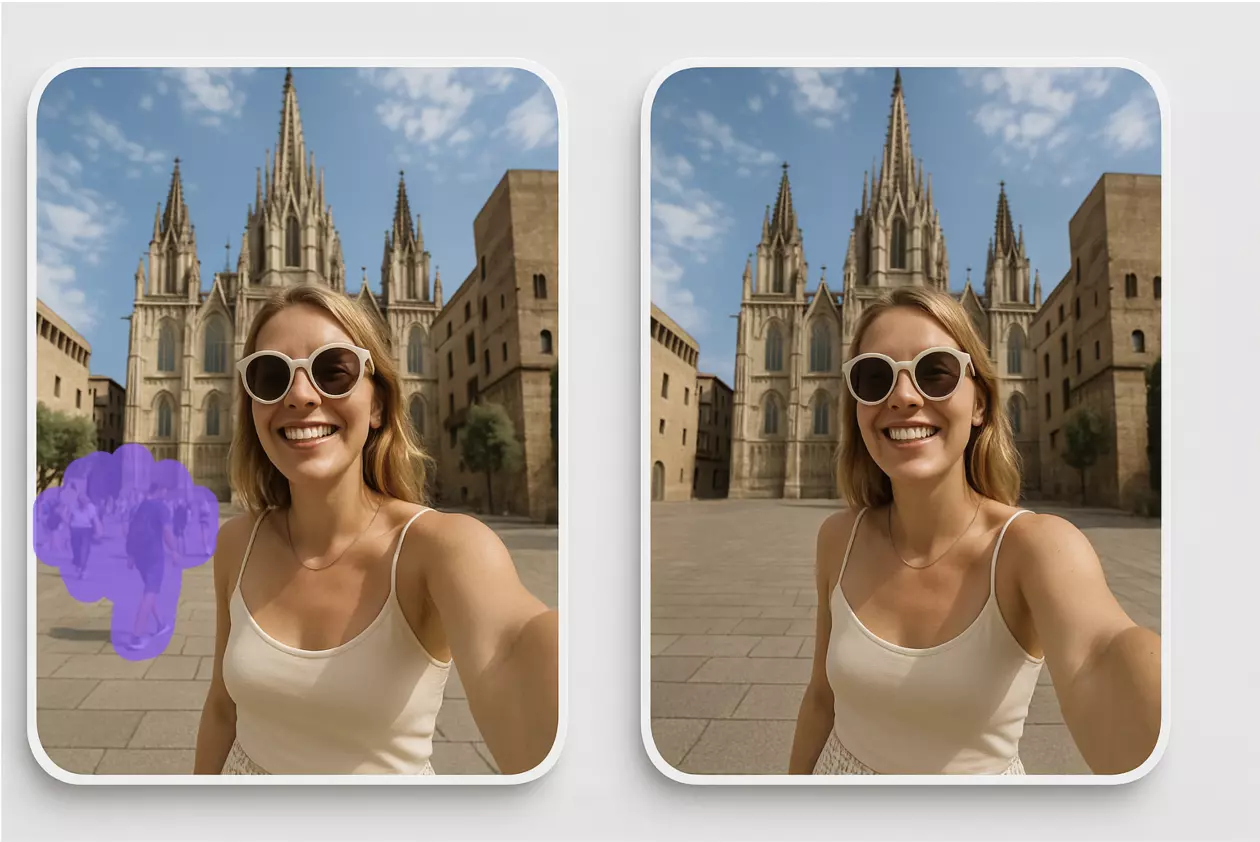
- Select the object remover: Brush over the person (include shadows/reflections when relevant) and let the AI process the selection.
- Preview and fine-tune: Inspect edges, patterns, and light; if needed, refine the selection and run again for a tighter result.
- Download the cleaned photo: Export in your desired resolution and format.
To get hands-on right away, you can remove people from photos in seconds and preview side-by-side to ensure the background reads naturally.
(See image: Pixflux.AI interface showing the three-step flow: upload the photo, AI processes the selection, preview and download the cleaned image.)
Background consistency checks: shadows, reflections, patterns, and grain
After removal, run this quick QA:
- Shadows: Does the light direction and softness match adjacent shadows? If you removed a figure casting a shadow, fill the shadow region with plausible light falloff.
- Reflections: Glass, polished floors, water, or chrome surfaces may show echoes of the removed subject. Erase or regenerate reflections to match.
- Patterns: Continue repeating elements without visible seams (bricks, tiles, fabric weave). Nudge filled areas with a warp or perspective tweak if lines drift.
- Grain and texture: Reapply a subtle layer of grain to the edited area so it doesn’t look overly smooth compared to the rest of the frame.
- Color cast: Interiors often have mixed lighting. Use local white balance or color grading so the patch inherits the same cast as its surroundings.
When to remove, replace, or regenerate backgrounds
- Remove: A single passerby in a clean environment (beach, plaza, hallway) usually needs only object removal.
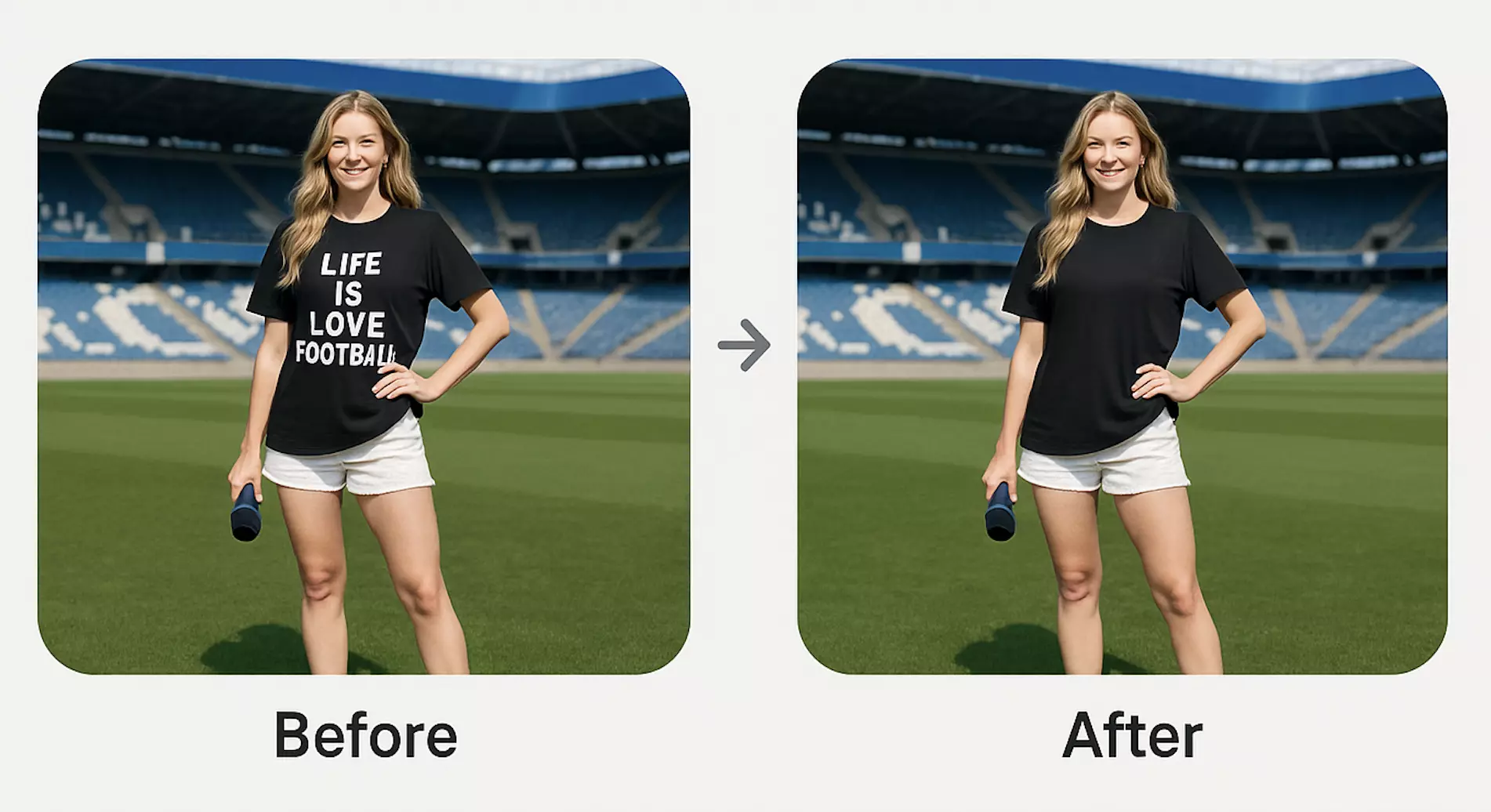
- Replace: If the background is chaotic or the subject separation is poor, swap in a cleaner backdrop while preserving subject contours and perspective.
- Regenerate: For holes left by removals in complex textures (dense foliage, patterned wallpaper), regenerate the missing area to maintain believability.
Pixflux.AI can help across these scenarios: remove a distracting person, replace an unsuitable backdrop with a more on-brand scene, or regenerate a portion of the background so lighting and texture stay consistent.
Batch cleanup for event galleries with Pixflux.AI batch processing
Covering a multi-day festival or a corporate summit often yields hundreds of frames with recurring distractions—staff in the aisle, attendees wandering through a product demo, or a stray vendor badge near the hero shot. With Pixflux.AI, you can upload multiple images and apply the same object removal workflow across a set, speeding up delivery while keeping a consistent look. This is particularly useful for:
- Social recaps where privacy is sensitive and faces must be minimized in the background.
- Press kits that require clean, distraction-free visuals.
- Client deliverables with tight turnarounds and standardized edits across a gallery.
Tip: Group similar scenes (same stage, lighting, background pattern) to streamline review and maintain continuity from image to image.
Case study: beach cleanup and quality checks
Scenario: A beach portrait has a blurred jogger and faint footprints intersecting your subject’s leading line. The goals are to keep sand texture, preserve the ripple pattern, and maintain the golden-hour shadow angle.
Workflow:
- Select the jogger and their elongated shadow. Remove in one pass.
- Inspect the sand ripples. If the fill smears, run a smaller, refined selection along ripple edges.
- Restore micro-texture: Add a light, uniform grain if the area looks too smooth.
- Check the subject’s shadow direction and ensure no conflicting remnants remain.
Result: A believable seaside frame where footprints and ripples read naturally, and the viewer’s eye returns to your subject. (See image: Before-and-after of a beach photo where a background stranger is removed while preserving sand texture, footprints, and shadow direction.)
Privacy and consent: a quick pre-post checklist for public spaces
Before you hit publish:
- Faces: Are any faces identifiable in the background? If yes, consider removal or heavy blur.
- Context: Could someone be embarrassed or harmed by being recognizable in this scene?
- Kids and sensitive spaces: Give extra care to minors, schools, hospitals, places of worship.
- Location data: Strip metadata if sharing to public channels.
- Client policy: Align with your client’s brand, legal, and regional regulations (US and global).
- Watermarks and logos: Only use watermark removal on images and marks you own or are authorized to edit. Do not remove third-party watermarks or trademarks to bypass usage rules or platform policies.
Ethics note: Removing people is not a tool to rewrite news or mislead. Use edits to protect privacy and improve clarity, not to distort meaning.
Troubleshooting tough scenes: crowds, glass, water, and repeating geometry
- Crowds: Remove in layers. Start with the most distracting figures, then refill gaps. Avoid over-smoothing large regions; alternate selections to break repetition.
- Glass and mirrors: Remove both the subject and their reflection. Rebuild background lines behind glass using perspective cues.
- Water surfaces: Waves and reflections change subtly. Regenerate small sections and ensure specular highlights and ripple directions match adjacent frames.
- Repeating geometry (bricks, fences): Run multiple small passes along line boundaries, not one big selection. Realign perspective if lines drift.
AI online tool vs traditional methods
- Time cost: Online AI removal usually takes seconds to a minute per image; manual clone/content-aware can take 5–20 minutes depending on complexity; outsourcing adds back-and-forth delay.
- Learning curve: AI tools like Pixflux.AI require minimal training; pro software techniques demand experience to match light, texture, and perspective convincingly.
- Batch efficiency: Batch uploads help you process sets consistently; manual workflows struggle to maintain speed and uniform quality at scale.
- Cross-team adaptability: A clear, repeatable online flow makes it easy for photographers, social managers, and designers to align on output without handing off heavy files or complex instructions.
FAQ: removing unwanted people, background cleanup, and privacy
What’s the fastest way to remove an unwanted person without harming the background?
Use an AI object remover to select the person (including shadows/reflections) and let the tool rebuild the scene from nearby textures. After the first pass, zoom to 100% to correct small artifacts and ensure patterns, grain, and light direction match the surroundings. A second, smaller selection usually perfects tricky edges.
How do I keep perspective and patterns believable after removal?
Match lines and repeats visually, then fine-tune with smaller selections along edges. Pay attention to bricks, tiles, and floorboards—if they drift, redo a narrow selection parallel to the pattern. Reapply subtle grain so the filled area doesn’t look too smooth.
Can I batch edit a whole event gallery with AI?
Yes, you can upload multiple images and repeat the same removal workflow to keep results consistent. Group similar scenes (same stage, lighting, background) for best continuity, and do a quick spot-check on a few images per scene before exporting the full set.
Will AI removals look obvious on social platforms like Instagram or TikTok?
No, if you preserve texture, light, and perspective, AI removals are typically invisible at social resolutions. Do a final check at feed and story aspect ratios, and avoid over-smoothing; slight grain helps masks blend on compressed platforms.
What about reflections and shadows—do I need to remove those too?
Usually yes; remove the subject and any direct shadows or reflections they create. Missing a reflection in glass or water is a common giveaway. If the light angle is strong, rebuild the background and ensure remaining shadows in the area stay coherent.
Is it okay to remove watermarks or logos during cleanup?
Only if you own the image and have explicit rights to edit or remove marks. Watermark or logo removal must not be used to infringe copyrights, bypass licensing, or violate platform rules. When in doubt, keep marks or seek permission.
How do I avoid over-editing when cleaning busy scenes?
Work in smaller selections, pass by pass, and keep an eye on texture scale and micro-contrast. If viewers’ eyes keep drifting to your patched area, reduce smoothing, add a touch of grain, and realign pattern edges until the area feels neutral.
Try it in minutes: Pixflux.AI three-step quickstart
- Upload your photo with an unwanted person
- Let the AI process your selection
- Download your clean, share-ready image
If you’re on deadline, you can erase strangers from pictures with AI and keep scene continuity—without learning heavy software or outsourcing.
Conclusion and next steps
Clean, privacy-conscious photos win attention and trust. With a simple, physics-aware checklist and an AI object remover, you can remove distractions while keeping continuity, perspective, light, and texture intact. For travel creators, event photographers, and social teams working at speed, Pixflux.AI delivers fast, believable results—and scales from single hero shots to entire galleries.
Ready to try it on your own images? Open the tool and remove people from photos in a few clicks, then run the quick privacy checklist before you publish.