AI Remove Text from Image: Bulk Workflow for Catalog Teams (SKU-Ready in Minutes)
Batch-clean text and watermarks from hundreds of SKUs, zoom in for flawless edges, and export consistent, marketplace-ready images—fast.
 Richard SullivanJanuary 23, 2026
AI Remove Text from Image: Bulk Workflow for Catalog Teams (SKU-Ready in Minutes)
If you manage a catalog, you’ve likely dealt with suppliers sending images covered with text overlays, date stamps, or watermarks. Marketplace policies on Amazon, Walmart, and eBay increasingly reject these assets, and rushing manual edits through Photoshop or freelancers often introduces halos or texture mismatches that show up at 200% zoom. Meanwhile, the SKU backlog keeps growing.
The fastest path forward is to standardize an online AI workflow that can remove text cleanly, handle batch uploads, and export consistent files. Tools like Pixflux.AI give you a dependable ai remove text from image process that scales from a handful of product shots to hundreds of SKUs in one session—without teaching every team member advanced retouching skills.
Market trend: Retail teams are moving production cleanup to cloud editors with batch controls and pixel-level quality gates. In practice, that means you can accelerate SKU onboarding and keep rejections near zero while raising image quality across brands.
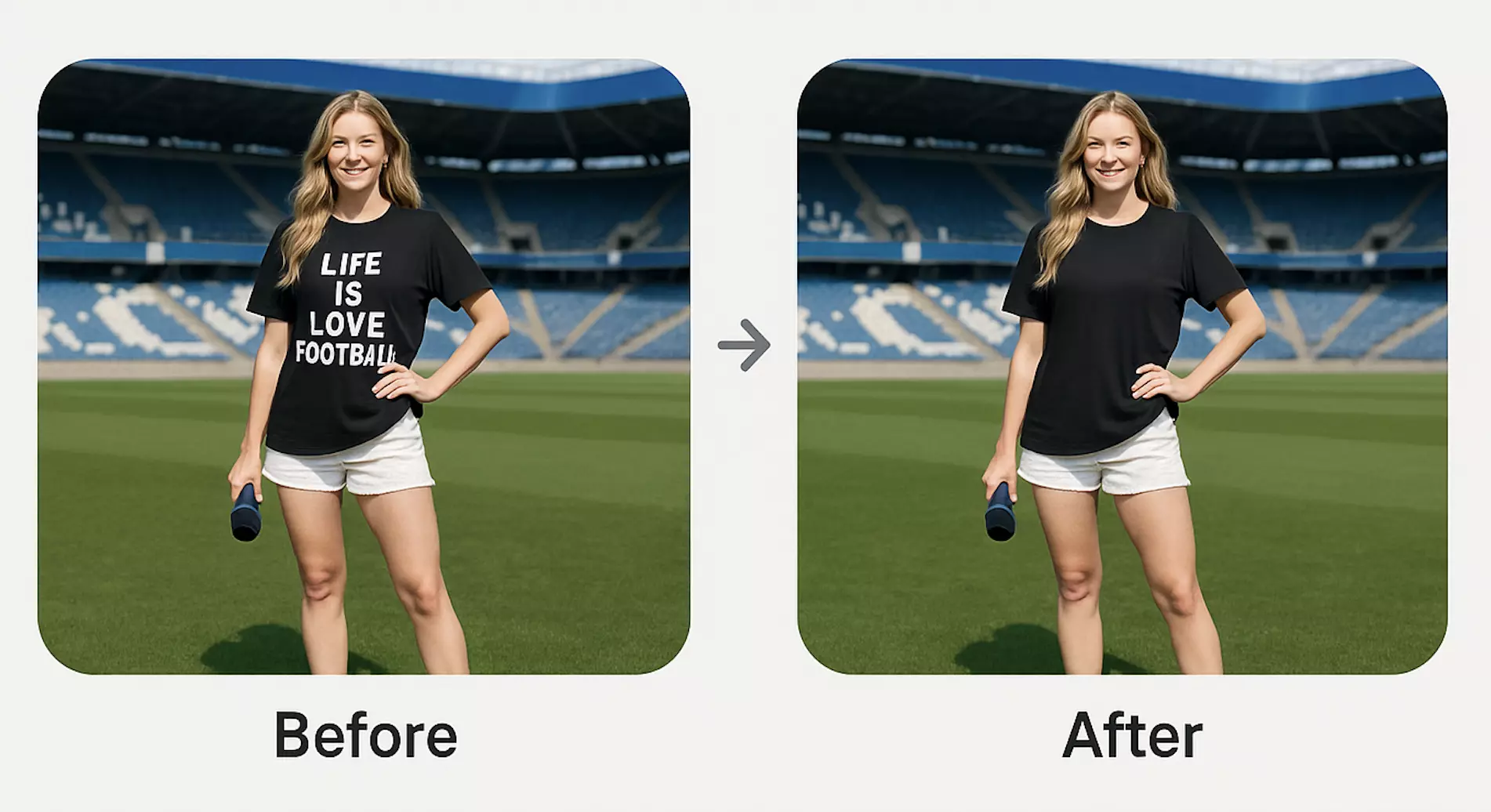
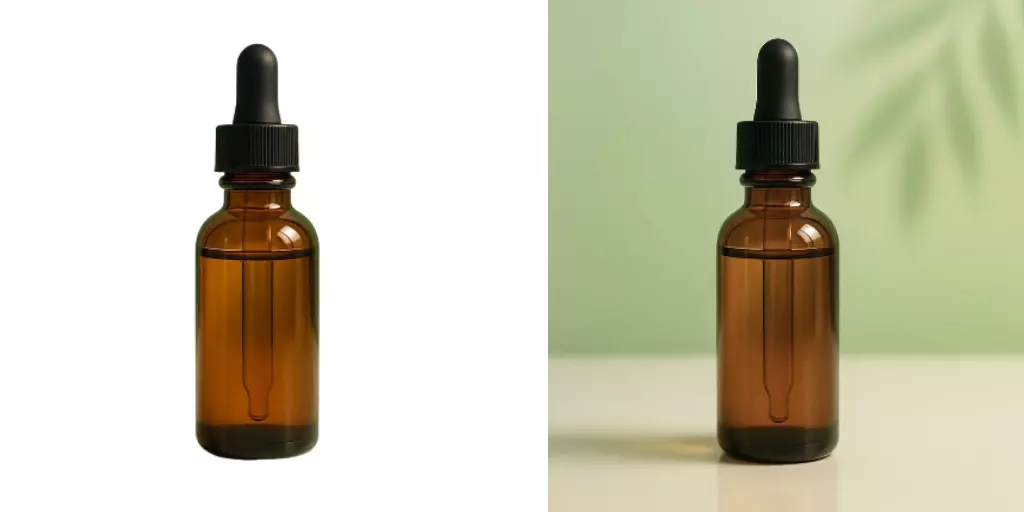
(See figure: Before-and-after comparison on the same product photo—text overlay and watermark removed in Pixflux.AI.)
Why catalogs need AI to remove text from images at scale
- Marketplaces reject text overlays and watermarks. Re-listing delays cost you sales and ranking momentum.
- Supplier images vary wildly. AI inpainting can normalize results across different backgrounds, materials, and resolutions.
- Teams need repeatability. A standardized workflow reduces subjective edits and training overhead.
- Backlogs are real. AI cuts turnaround from days to minutes, keeping launch calendars on track.
Beyond text cleanup, most catalog teams also need quick fixes like removing stray reflections, clearing dust or stickers, and enhancing clarity. AI can roll these into the same session, so your files leave the pipeline SKU-ready.
Key terms: text overlays, watermarks, artifacts, and inpainting
- Text overlays: Visible letters, captions, or badges added on top of the image. Often low-opacity or high-contrast.
- Watermarks: Semi-transparent brand or distributor marks. They blend into the texture and can stretch across the frame.
- Artifacts: Unwanted visual residues after edits—halos, blotches, or smeared textures that appear at close zoom.
- Inpainting: The AI technique that fills in missing or removed regions by synthesizing plausible background or surface texture.
Understanding these helps you brief your team and evaluate output quality consistently.
Online vs desktop tools: speed, quality, cost, and team workflow
- Speed: Online tools process in the cloud, so batch jobs complete faster and don’t depend on high-end local hardware.
- Learning curve: Browser-based AI tools are designed for non-specialists; Photoshop-level masking skills aren’t required.
- Batch processing: Modern cloud editors handle bulk uploads, parallel processing, and quick re-runs when needed.
- Cost and flexibility: You pay for what you use and avoid maintaining licensed desktop installs on every machine.
- Team workflow: URLs and consistent presets are easier to share in SOPs, enabling cross-functional teams to execute the same playbook.
Pixflux.AI exemplifies this approach with simple controls for bulk text and watermark removal, plus adjacent tools for background cleanup, object removal, and enhancement when your product set needs more than one pass.
File prep for bulk jobs: naming, SKUs, and safe originals
- Keep originals safe: Duplicate your source set; never overwrite originals. This allows reprocessing or upgrades later.
- Use SKU-based names: e.g., BRAND_SKU_VARIANT_01.jpg. Avoid spaces and special characters.
- Group by background/material: Leather, fabric, glass, metal behave differently. Grouping makes QC faster.
- Note platform specs: Square vs portrait, minimum pixel dimensions, background requirements (e.g., pure white for certain marketplaces).
- Flag “no-edit” areas: Text printed on packaging or mandatory labels may need to remain intact for compliance photos.
Use Pixflux.AI to batch remove text and watermarks: a 3-step online workflow
Here’s a practical, repeatable flow catalog teams can adopt. It works for both small test batches and full seasonal drops.
- Upload your images
- Open Pixflux.AI, choose the text removal tool, and upload multiple product photos at once. Keep a backup of your originals.
- Tip: Group similar materials so you can QC faster.
- Let AI process the images
- Run the removal pass to clean text overlays and watermarks. For tricky areas, use the mask brush to target specific regions.
- If the image also needs cleanup (stray labels, reflections), apply object removal or background edits in the same session.
- Download the results
- Preview outputs, spot-check at 200% zoom, then download individual files or the full batch.
- You can start right away with an online text remover from image to test your first SKU set.
(See figure: Pixflux.AI interface showing the 3-step flow—upload image, AI process, download result.)
Advanced: a 5-step pass for complex overlays
For dense watermarks or text across textured materials, add two extra steps for precision.
- Open Pixflux.AI’s text removal tool.
- Upload the original image batch.
- Select the text removal tool; paint masks over the exact regions; run AI.
- Inspect at 200% zoom. If you see halos or texture repetition, re-run with a tighter mask or smaller brush.
- Download clean outputs. If some areas still look off, try a second pass or lightly enhance clarity to harmonize texture.
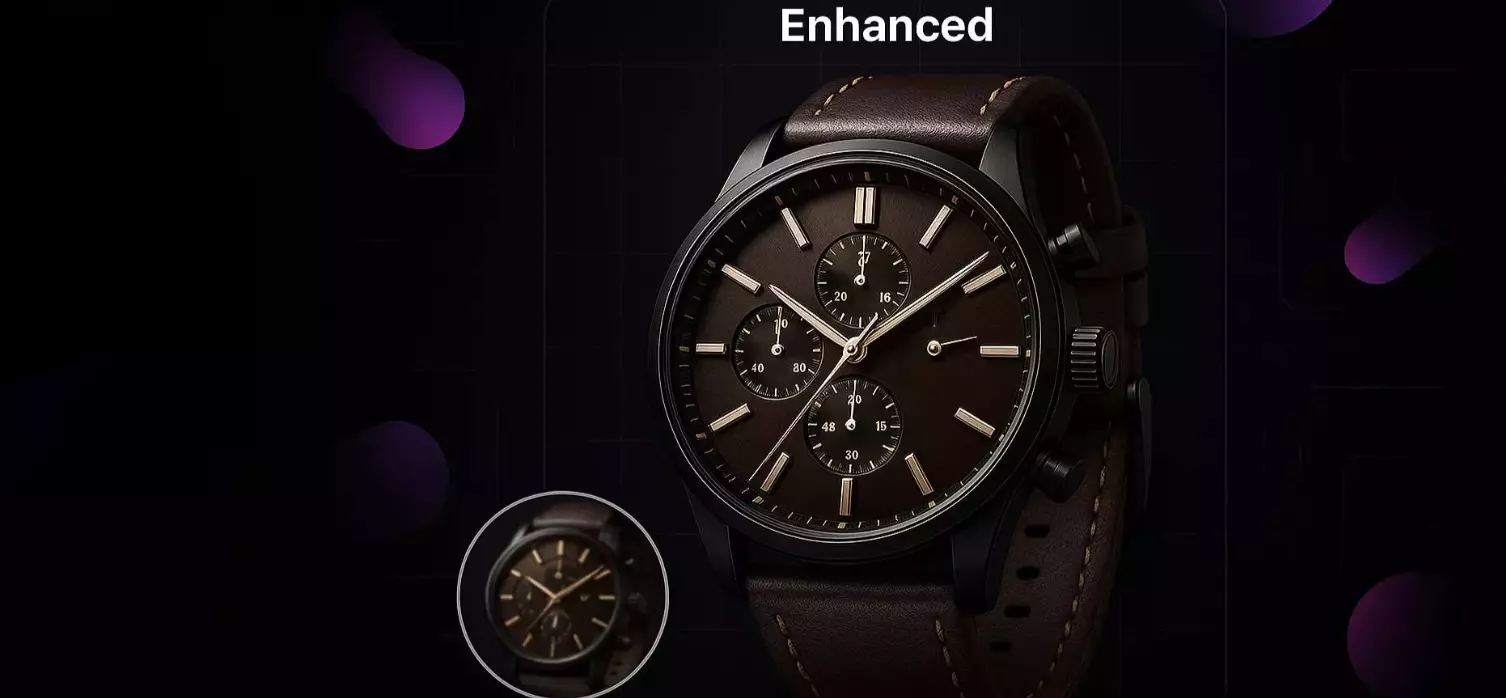
(See figure: Close-up at 200% zoom highlighting edge blending and texture restoration after text removal.)
Quality control checklist at 200% zoom: edges, textures, shadows, halos
- Edges: Lines should remain straight; no kinks or stair-stepping where text was removed.
- Texture continuity: Wood grain, fabric weave, brushed metal, or skin should look natural, not smudged or repetitive.
- Shadows and reflections: If text sat over shadows, ensure transitions are smooth and believable.
- Halos: Look for bright/dark rings around the previously text-covered area.
- Color consistency: No localized shifts; the patch should match surrounding hues.
- Product integrity: Printed-on labels or legally required markings should remain intact if they’re part of the product.
Tip: Check the exact areas that marketplaces scrutinize—center mass of the product and any high-contrast regions.
Advanced settings: masks, prompts, and when to re-run AI passes
- Masks first: Targeting only the text area reduces risk of over-editing. Use a small brush for detailed materials.
- Multiple passes: If artifacts persist, run a second pass rather than increasing mask size too aggressively.
- Texture-aware prompts: If the tool supports light guidance, mention the surface (e.g., “brushed steel,” “matte leather”) to improve inpainting consistency.
- Adjacent fixes: After removal, consider quick image enhancement to restore micro-contrast, or remove small distracting objects left by suppliers. Pixflux.AI includes these adjacent tools so your final looks cohesive.
Export standards for marketplaces and ads: formats, color, size, DPI
- Format: JPEG for product listings (sRGB), PNG for assets requiring transparency.
- Size: Follow marketplace minimums—often 1000–1600 px on the longest edge to enable zoom; ads may need larger.
- Color space: sRGB for web; ensure consistent profiles across the batch.
- DPI: 72–96 for web; 300 for print collateral.
- Background: Solid white or brand-consistent neutral per channel guidelines; avoid banding in gradients.
- Naming: SKU-based, no spaces, version suffix if needed (SKU_01_v2.jpg).
- Consistency: Apply the same export preset across the collection to simplify re-use in ads and PDPs.
Compliance and ethics: watermarks, licensing, and alteration disclosures
- Ownership first: Only remove text or watermarks on images you own or are licensed to edit. Respect brand and photographer rights.
- Marketplace rules: Some channels require disclosure if the image was altered beyond basic cleanup. Check your target marketplace policies.
- Product truth: Don’t remove text that represents actual product features or safety information required on packaging.
Note: Watermark removal should never be used to infringe copyrights or bypass platform rules.
Troubleshooting common failures in AI text removal
- Ghosting remains where text was removed
- Re-run with a tighter mask; zoom to 200% and brush only the affected strokes. A second pass usually clears residual bands.
- Warped lines on hard surfaces (e.g., laptops, furniture edges)
- Reduce mask size and follow the edge direction. If needed, run a light enhancement afterward to normalize micro-contrast.
- Repetitive texture tiles on fabrics or wood
- Make the mask irregular and smaller; avoid covering large uniform areas in a single pass. Two smaller passes look more natural.
- Embedded logos or embossed text on the product
- If the text is part of the actual product surface, consider leaving it; marketplaces may require accurate representation.
- Smears on shadows or reflections
- Mask only the text, not the entire shadow gradient. If a shadow is damaged, re-run with a softer brush and blend along the gradient.
AI online tools vs traditional methods
- Time cost: Online AI finishes in minutes, even at scale; manual masking can take hours per batch.
- Skill requirement: Non-designers can run the AI workflow; Photoshop requires trained retouchers for comparable quality.
- Batch efficiency: Cloud tools process many files concurrently; freelancers or desktop scripts may bottleneck.
- Cross-team adoption: A single, shareable link and a simple SOP make it easy for merchandising, content, and ads teams to use the same steps.
- Quality consistency: Built-in AI inpainting reduces human variation; QC at 200% keeps standards high.
For many catalog teams, Pixflux.AI is the pragmatic middle ground: fast online processing, batch-friendly UX, and adjacent tools for background cleanup, object removal, and image enhancement when a SKU set needs more than text removal.
FAQ: ai remove text from image for catalogs, workflows, and free options
Is AI good enough to remove text from images for production catalogs?
Yes, modern AI inpainting is production-ready when paired with a simple QC checklist. Use 200% zoom to verify edges, texture continuity, and halos. For tough cases, a second pass with a tighter mask typically reaches marketplace-ready quality.
Can I remove watermarks legally?
Only if you own the image or have explicit permission to edit it. Always check licensing terms from photographers or suppliers. Marketplace rules also apply—do not remove marks that indicate required attributions or change the product’s truthful representation.
How can I process hundreds of SKUs quickly?
Use a bulk-friendly online editor and standardize your SOP. Batch-upload images, run AI removal, then audit a sample at 200% before exporting the full set. Pixflux.AI supports batch workflows so catalog teams can move from cleanup to export in one session.
Will marketplaces accept AI-edited images?
Yes, as long as the output meets their technical and content policies. Focus on accuracy and clarity: no added promotional text, correct background, and sufficient resolution. Keep any mandatory labels visible if required by your category or region.
What if the text is printed on the product itself?
Leave it intact unless you have a specific, compliant reason to edit it. Embedded text (e.g., logos on apparel or engravings on hardware) is part of the product. Removing it can mislead shoppers or violate listing rules.
Do I need advanced retouching skills to use this workflow?
No, the AI workflow is designed for non-specialists. A short onboarding covers masking, re-running passes, and basic QC. Most edits involve a simple 3-step flow with minimal manual intervention.
What output settings should I use for eCommerce and ads?
Use JPEG sRGB at marketplace-recommended sizes and PNG for transparent assets. A practical baseline is 1500–2000 px on the longest edge for listings with 80–90% JPEG quality; adjust for your marketplace or ad platform specs.
Can I try an AI text remover free before scaling up?
Yes, you can start with limited free usage to validate quality and fit. Once your QC checklist passes, move to a paid plan that supports your monthly SKU volume and required turnaround times.
Conclusion and next steps
A reliable “AI remove text from image” workflow helps catalog teams ship new SKUs faster, pass marketplace checks on the first try, and keep brand visuals consistent. Standardize your file prep, run a quick 3-step batch pass, and audit results at 200% zoom before exporting. When background cleanup, object removal, or small enhancements are needed, keep it in the same session so your output is SKU-ready without extra handoffs.
If you’re ready to move from ad-hoc fixes to a repeatable playbook, start with an ai remove text from image test batch and validate the quality against your highest-priority SKUs. For hands-on practice, open Pixflux.AI’s text remover, upload a small set, and run the inpainting flow. When it’s time to scale, keep your SOP tight and your quality gates simple.
Clean catalogs win. Try an online text remover from image now, and when you’re satisfied with the results, roll the process out to the full team. If you want a quick start with no commitment, you can also explore a remove text from image ai free trial to benchmark speed and quality on your own product set.
(See figure: Before-and-after comparison and a 200% zoom inspection of edge blending and texture recovery in Pixflux.AI.)