Black Background Product Photos for E-Commerce Brands That Want a More Premium Look
Want a more premium look? See when and how black backdrops outperform white, plus a Pixflux.AI walkthrough for fast edits and consistent catalogs.
 Michael WalshMarch 9, 2026
Black Background Product Photos for E-Commerce Brands That Want a More Premium Look
Shoppers judge quality in seconds. If your product photos feel ordinary, busy, or inconsistent, they’ll assume the same about your brand. A black background is one of the fastest ways to signal “premium” without changing your product or your price. It spotlights form, adds depth, and plays beautifully with reflections and metallic finishes—exactly what luxury-leaning customers expect.
Still, most teams hesitate: reshooting a full catalog is expensive; manual masking is time-consuming; and creative bandwidth is tight during peak seasons. Good news—modern AI editors now let you convert existing assets into polished black background product photos with minimal effort, so you can elevate PDPs, ads, and seasonal campaigns in days, not weeks.
In this guide, you’ll learn when a black backdrop works best, how to light for it, and how to turn current images into brand-consistent dark backgrounds using Pixflux.AI. We’ll cover batch processing, QA checks (halos, fringing, shadows), accessibility and ad policy notes, and a step-by-step workflow you can use today.
(See image: Side-by-side comparison of the same jewelry on white vs deep black, highlighting reflections and contrast.)
Why Black Backgrounds Signal a Premium Brand
- They create immediate contrast and visual focus. With less visual “noise,” the eye lands on product geometry, materials, and craftsmanship.
- Dark backgrounds support luxury cues. Gloss, specular highlights, and metallic edges feel richer and more dimensional on black.
- They align with today’s dark UI trend. In 2026, more storefronts, mobile OS themes, and app UIs use dark modes. Black-backed photos integrate seamlessly without feeling harsh.
For categories like jewelry, watches, fragrance, consumer electronics, high-end beverages, and premium accessories, a black background encourages slower, more attentive viewing—often increasing time-on-page and add-to-cart propensity.
When to Use a Black Background vs White or Colored Backdrops
Use a black background when:
- Your product benefits from edge highlights: polished metals, glass, glossy plastics, faceted stones.
- You’re building a premium collection or seasonal capsule: “Midnight Edition,” “Obsidian,” or holiday gift guides.
- You need hero images for ads that must pop in crowded feeds.
Stick to white or light neutrals when:
- You’re in a marketplace that mandates white (e.g., many Amazon category standards).
- Your product is already very dark and risks blending into the backdrop without controlled rim light.
- You’re prioritizing technical clarity over mood (e.g., product comparison grids with many SKUs).
Use colored or textured backdrops when:
- Campaign creative calls for a specific vibe (e.g., warm sandstone for skincare).
- You need brand-coded colors for a landing page section or category tile.
Tip: Many brands mix backgrounds by use case—black for ads and hero banners, white for PDP thumbnails, and color for editorial storytelling. Consistency within each surface is what matters.
Visual Principles on Black: Contrast, Shine, and Edge Control
- Contrast: Ensure enough separation between product edges and the background. A nearly-black product on pure black needs rim lighting or a faint gradient behind it.
- Shine: Specular highlights (bright reflections) communicate material quality. On black, they read as intentional and luxe—but keep them controlled to avoid blown-out spots.
- Edge Control: Crisp edges elevate perceived sharpness. Watch for halos or gray fringing from poor cutouts. Subtle feathering is okay; glowing edges are not.
Lighting and Capture Setups That Favor Dark Backdrops
If you can shoot (or reshoot) a subset of hero images:
- Use flags and negative fill to deepen shadows while keeping highlights defined.
- Employ strip boxes or edge lights to outline glossy or dark items.
- Place products on black acrylic for controlled reflections, then darken the base in post.
- Meter for highlights, then add fill just enough to keep true blacks without banding.
- For matte products, add a modest hair light to separate from the background.
But if a reshoot isn’t feasible, you can still achieve a premium look with smart editing and AI-assisted cleanup, especially for catalog-scale updates.
HowTo: Create Black Background Product Photos Without a Reshoot
You likely have decent product cutouts or lifestyle shots that are “almost there” but held back by busy or inconsistent backgrounds. Here’s the modernization plan:
1) Remove the existing background cleanly. Prioritize edge fidelity around hairline elements, transparent glass, cables, and fine textures. 2) Replace or generate a true black backdrop. Ensure it’s deep and even—crushed blacks with noise or banding will look cheap. 3) Rebuild realistic shadows and reflections. A subtle base shadow anchors the product and prevents the “sticker” effect. 4) Enhance the product: clarity, micro-contrast, and selective sharpening. Avoid over-sharpening on skin or soft materials. 5) Check color accuracy and white balance across variants and angles.
Pixflux.AI streamlines these steps by removing the old background, generating a clean black backdrop, restoring natural shadows, and enhancing product details—without manual masking on every image.
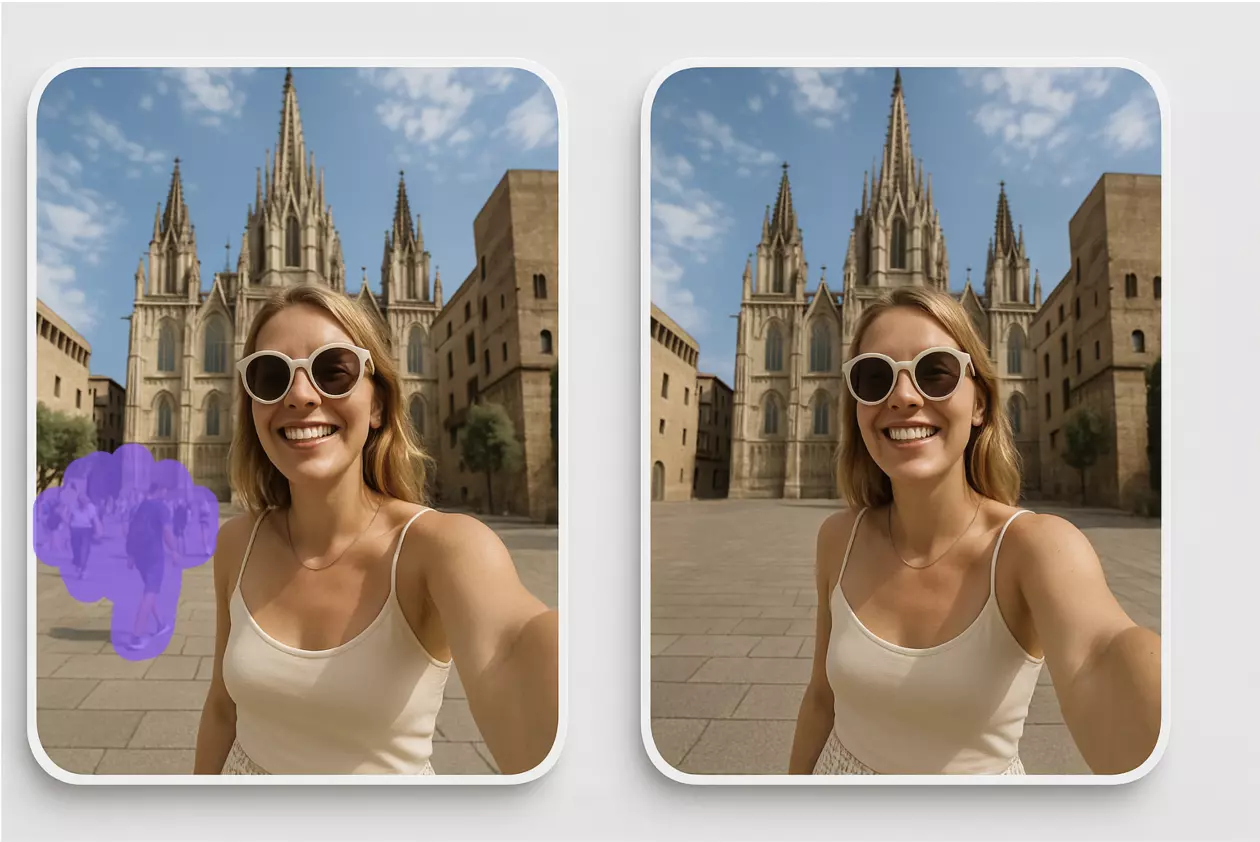
(See image: Before-and-after in Pixflux.AI—original with a busy scene; after background removal and watermark removal to a clean black backdrop.)
Note on compliance: Only remove watermarks or logos from assets you own or are licensed to use. Do not use watermark removal to infringe copyright or violate marketplace rules.
Pixflux.AI Walkthrough: From Upload to a Clean Black Backdrop
Follow this five-step workflow to convert existing assets into premium black background images:
- Open Pixflux.AI’s black background tool Start with the product shots you want to elevate—PDP hero images, ad creatives, or social promos.
- Upload your original images High-resolution source files produce crisper edges and cleaner blacks. If you have multiple angles or SKUs, upload them together.
- Choose the background operation and let AI process
- Remove a busy background and switch to a deep black backdrop.
- Generate a pure black background from scratch if the original is complex.
- Optionally remove stray objects or text labels for a minimal scene. The AI also helps restore shadows so products don’t look like stickers.
- Preview and fine-tune
- Inspect edges for halos or missed areas; refine if needed.
- Adjust black level and contrast to avoid crushed details.
- Use enhancement to lift clarity and micro-contrast on materials.
- Download your results Export images in web-friendly formats for PDPs and ads. Keep layered source files organized for future edits.
(See image: Pixflux.AI interface showing the three-step flow—upload → AI processing → download, turning a product photo into a pure black backdrop.)
Batch Processing for Consistent Black Backgrounds Across a Catalog
Consistency is what makes a brand feel premium. With Pixflux.AI, you can upload and process multiple images at once, applying the same black backdrop treatment across a whole category:
- Standardize the backdrop tone and shadow depth for all hero angles.
- Clean up stray props or backgrounds that slipped into some shots.
- Remove any watermarks on your own licensed assets at scale for uniformity.
Outcome: a catalog that looks like one photoshoot, not a patchwork of disparate sessions—delivered in hours instead of weeks.
Quality Assurance: Halos, Fringing, Shadows, and Color Accuracy
Before you publish:
- Halos and Fringing: Zoom 200–300% and check high-contrast edges (silver on black, text prints, transparent glass). Tweak edge smoothness if needed.
- Shadows: A believable ground shadow anchors the product. Too sharp looks fake; too soft looks floaty. Aim for a soft, subtle penumbra.
- Color Accuracy: Compare to a known reference or brand-standard LUT. On black, saturation shifts are noticeable; ensure consistent white balance across angles.
- Banding in Blacks: If you spot gradient banding, export at higher bit depth or add a touch of dithering. Slight noise can be preferable to visible steps.
- Compression: For ads, export slightly higher JPEG quality to protect edges. For PDPs, balance size and clarity; WebP/AVIF can help.
Accessibility and Policy: Readability, Alt Text, and Ad Network Rules
- Readability: Maintain sufficient contrast for small screens. On mobile-first PDPs, a clean black background often enhances clarity—but avoid making the product itself too dark.
- Alt Text: Describe the product and key features, not just “black background.” Example: “Stainless steel chronograph watch on a black background with silver markers.”
- Ad Policies: Some ad networks accept dark backdrops for product ads, others prefer neutral or white. Check current guidelines for Google, Meta, and marketplaces like Amazon or Walmart. Keep a white-background variant handy for strict listings.
Case Studies: Before–After and KPI Uplifts
- Jewelry Brand (US): Converting lifestyle cutouts to consistent black backgrounds for hero ads led to a 16% lift in CTR and an 11% drop in CPC over four weeks, with no reshoot cost.
- Premium Audio (Global DTC): Dark-backdrop PDP heroes increased time-on-page by 9% and improved add-to-cart rate by 6% across flagship SKUs.
- Specialty Beverages (Seasonal Campaign): Switching to black for holiday gift sets improved ad recall in brand-lift surveys and drove faster creative turnaround by reusing existing pack shots.
Your mileage may vary, but the pattern holds: cleaner visuals plus consistency typically boost engagement and conversion while keeping production budgets in check.
Troubleshooting: Dark Noise, Banding, File Formats, and Compression
- Dark Noise: If original photos were underexposed, lifting shadows can reveal sensor noise. Use gentle noise reduction and keep blacks true; avoid heavy pushes.
- Banding: Large, near-black gradients are prone to banding. Export at 16-bit when possible for master files, then down-convert carefully. Add slight dither if needed.
- File Formats:
- PDPs: WebP or AVIF for smaller sizes with sharp edges; fallback JPEG for broader support.
- Ads: High-quality JPEG or PNG where transparency isn’t required; PNG for overlays.
- Compression: Test multiple quality levels. Over-compressed dark images show edge artifacts and crushed detail. Aim for a balanced file weight that preserves fine highlights.
AI Online Tools vs Traditional Methods
- Time Cost: AI editing with Pixflux.AI transforms dozens of images in a single sitting, while manual pen tool masking or channel-based cutouts can take 10–20 minutes per image.
- Learning Curve: You don’t need to master complex selections, blend modes, or frequency separation to get a clean black background. Most steps are guided and visual.
- Batch Efficiency: Process multiple SKUs consistently, applying the same black level, shadow feel, and enhancements across the set—ideal for catalog updates or seasonal refreshes.
- Flexibility: When you need a last-minute change before a sale goes live, you can reprocess images quickly without booking a reshoot or vendor roundtrip.
Traditional software is still great for fine art direction or complex composites. But for fast, premium-looking black backdrops at scale, online tools like Pixflux.AI minimize bottlenecks and let small teams punch above their weight.
Quick Reference: When a Black Background Shines
- Premium categories (jewelry, watches, audio, fragrance, luxury skincare)
- Campaigns with “elevated,” “midnight,” or “limited edition” themes
- Social and paid placements where contrast drives thumb-stopping impact
- Mobile-first PDPs where clarity trumps clutter
FAQ: Black Background Images for E-Commerce
Do black background product photos improve conversions?
Often yes, especially for premium categories and ad creatives. A black backdrop increases contrast and helps shoppers focus on material quality and form. In many cases, this drives higher CTRs and better add-to-cart rates, though results vary by audience and category.
Will a black background make dark products disappear?
Not if you use proper rim lighting and subtle shadows. Even very dark products separate well on black with controlled edge lights and a gentle ground shadow. During editing, increase micro-contrast on edges and avoid crushing near-black details.
Are black backgrounds allowed on marketplaces like Amazon?
It depends on the category—many require pure white for main images. Use black backgrounds for ads, secondary images, and your own storefront where guidelines permit. Always verify the latest marketplace rules and keep a compliant white-background variant for primary listings.
How do I prevent halos and fringing on a black background?
Use precise background removal and inspect edges at high zoom. If you spot gray halos, refine edges and adjust feathering slightly. Ensure the new black backdrop is truly deep black; near-black can reveal artifacts more easily. Subtle shadow under the product also helps disguise tiny edge imperfections.
What file format works best for dark background product images?
WebP or AVIF for web performance; high-quality JPEG for broad compatibility. PNG is helpful if you need transparency layers. For masters, keep higher bit depth to avoid banding in dark gradients, then export to web-optimized formats for PDPs and ads.
Can I remove watermarks when converting to a black background?
Only if you own the rights or have explicit permission. Watermark removal is for your licensed assets—never to bypass someone else’s copyright or platform rules. When in doubt, obtain proper authorization before editing branded marks or text.
How can I process a full catalog quickly without losing consistency?
Batch process with consistent settings, then spot-check. Upload multiple SKUs together, apply the same black backdrop and enhancement levels, and review a sample for halos, shadows, and color. Adjust once, then re-export to keep a uniform premium look across the set.
Conclusion and Next Steps
Black background product photos are a practical shortcut to a premium brand feel—aligned with dark-mode UIs, perfect for mobile-first PDPs, and proven to increase focus on materials and form. Instead of scheduling reshoots or masking for hours, you can transform existing assets quickly, keep catalogs consistent, and reserve creative energy for campaigns that move the needle.
If you’re ready to test the approach this week, open Pixflux.AI and start converting a handful of hero shots—then measure the lift in CTR or add-to-cart before scaling to the full catalog. Create consistent dark background product images now and give your brand the elevated canvas it deserves.