Generative Design at Scale Change Background Colors Without Reshoots
Scale seasonal, regional, and A/B-ready product images by changing backgrounds—without reshoots—and keep brand colors accurate across your catalog.
 Michael WalshJanuary 10, 2026
Generative Design at Scale: Change Background Colors Without Reshoots
Holiday drops, regional campaigns, and A/B tests all demand fresh looks—often on short timelines. But coordinating reshoots across a full catalog is expensive, slow, and risky for color fidelity. Meanwhile, mismatched backgrounds on your PDPs and PLPs dilute brand perception and make your catalog feel disjointed.
In 2026, retailers increasingly rely on generative design to localize creative without reshoots. If your goal is to consistently change background color across hundreds of SKUs—while keeping brand color accuracy tight—you can now do it in hours, not weeks. An online AI workflow like Pixflux.AI lets teams change background color consistently, measure results, and deploy seasonal or regional variants with confidence.
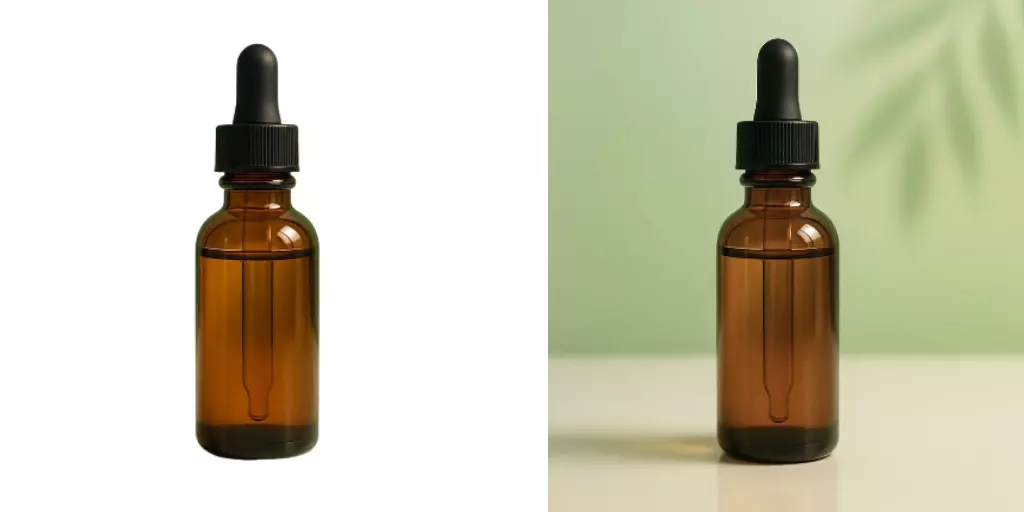
(See figure: Before-and-after composite showing the same product on a neutral gray vs brand-approved spring and holiday background colors generated with Pixflux.AI.)
Why background color consistency matters for catalogs and CRO
Consistency drives recognition. When product backgrounds align to your brand palette across the catalog, browsing feels smoother and more premium. That consistency improves:
- Visual hierarchy: Uniform backgrounds let product shape and surface details pop.
- Speed to value: Shoppers scan thumbnails faster on category or search pages.
- Trust and brand recall: Predictable visuals feel intentional—not improvised.
From a CRO standpoint, background color can be a controllable lever. A/B testing background hues on PDPs and PLPs is now a standard tactic. Subtle shifts—e.g., a less saturated variant for tech SKUs, a warmer hue for soft goods—can lift CTR or add-to-cart without changing the product itself. The key is being able to create variants quickly and keep brand color accuracy measurable.
Core concepts: background change vs replacement vs recoloring
Before scaling, align on terminology so briefs don’t get lost in translation:
- Background change: Adjust the hue or tone of the existing background while preserving its lighting cues. Best for subtle palette alignment.
- Background replacement: Remove the existing background and swap in a new, clean background (flat color or lightly textured studio). Often used for marketplace compliance or global standardization.
- Recoloring: Precisely map backgrounds to specific brand colors (e.g., HEX or Pantone) and maintain consistency catalog-wide. This is the foundation of seasonal and regional variants.
For product catalogs, most teams use background replacement for a clean, consistent base, and then apply controlled recoloring to match brand swatches.
Color accuracy fundamentals: brand palettes, ICC profiles, lighting assumptions
If you care about measurable color accuracy, put the following fundamentals in place:
- Brand palette definitions: Keep a single source of truth for brand-approved colors in HEX, RGB, and CMYK. Include notes for “on-screen” vs “print-equivalent” display and permissible tolerances.
- ICC and working spaces: For web images, sRGB is the safest default. If you create wide-gamut assets (e.g., Display P3) for high-end devices, maintain conversions carefully. Always embed the profile on export.
- Lighting assumptions: Background color perception changes with shadows and reflections. Aim for backgrounds that complement the product’s lighting direction; if you fully replace backgrounds, match the light angle and softness to avoid floating or cutout looks.
- Measurable targets: Use Delta E (CIEDE2000) to quantify “close enough.” For critical brand colors, Delta E ≤ 2.0–3.0 is a common threshold; for supporting accents, ≤ 4.0–5.0 is often acceptable.
Measure color, then scale. A quick calibration pass now saves rework across hundreds of SKUs later.
Plan at scale: seasonal, regional, and A/B variants without reshoots
Avoid chaos by treating background color variants as a productized workflow:
- Variant naming: Adopt a naming structure like <SKU><region><season>_<bgColorCode>. Keep it machine-readable for downstream asset management.
- Palette mapping: Map each merchandising theme (Spring, Holiday, Back-to-School) to 1–3 brand-approved backgrounds per category. Keep contrast in mind for product families.
- Regional localization: Align with regional norms and marketplace requirements (e.g., neutral backgrounds in some marketplaces vs vibrant brand tones on DTC).
- A/B test harness: For PDP and PLP experiments, only vary background color. Keep angles, crops, and lighting identical so you isolate the signal.
- Governance: Set sign-off rules for color-critical launches and embed QA steps (Delta E checks, viewport tests) before publishing.
Tooling comparison: online editors vs desktop suites for background color changes
- Online AI tools: Fast setup, minimal learning curve, and strong subject isolation. Ideal for rapid catalog-wide consistency and quick A/B variants. Teams can align on a simple three-step flow without installing software.
- Desktop suites (e.g., pro editing software): Deep control, especially for complex composites. Best for hero images or high-touch creative. Heavier learning curve and slower for bulk variants.
- Outsourcing: Scales labor easily but adds communication loops, slower iterations, and quality variance. Better for routine clipping tasks than nuanced color governance.
For most catalog scenarios in 2026, the sweet spot is a hybrid: use an online AI workflow for 80–90% of background changes, then escalate special cases to specialists.
How to set up a color-managed workflow and QA checklist
Use this checklist to reduce guesswork and avoid rework when you change background color at scale:
- Centralize brand colors
- Store HEX/RGB values, usage notes, and tolerances in one shared doc.
- Define the working color space
- Use sRGB for web deliverables; document when P3 is permitted and how to convert.
- Standardize lighting intent
- For flat-color backgrounds, specify acceptable shadow softness and direction.
- Prepare input files
- Use the highest-resolution versions available; avoid over-compressed JPGs.
- Background strategy
- Decide which SKUs get background replacement vs recolor; document per category.
- QA instrumentation
- Set target Delta E thresholds for brand colors and define the spot-check method.
- Accessibility and contrast
- Ensure adequate contrast between the product edge and background for clarity; if adding overlays, meet WCAG contrast guidelines.
- Export rules
- PNG or WebP for transparency and crisp edges; JPG/WebP for speed on PLPs. Always embed sRGB unless a specific profile is required.
- Final review
- Review on calibrated displays and a representative mobile device. Check key SKUs in bright/dark modes and common viewport sizes.
Hands-on: change background color in Pixflux.AI in three steps
When you’re ready to execute a clean swap or recolor, follow a simple three-step flow in Pixflux.AI:
- Upload your original image
- Choose a representative product shot or batch-select multiple SKUs.
- Let the AI process the image
- The subject is isolated automatically, and you can set a new background or apply brand color values for precise recoloring.
- Download the result
- Preview edge quality and color match, then export in your required format.
To get started quickly, open Pixflux.AI and change image background color on a single product photo to validate your color mapping before scaling.
(See figure: Pixflux.AI interface showing the three-step flow—upload, AI processing, and download—on a sample product.)
Batch workflows: apply background color changes across SKUs in Pixflux.AI
Once you’ve validated a color variant on a few items:
- Batch upload multiple images and apply the same background color preset across the set.
- Use consistent cropping and edge refinements so the collection feels cohesive in a grid.
- If you need to localize a campaign, duplicate the batch and swap in regional background colors, keeping everything else identical for clean measurement.
Pixflux.AI supports batch processing so you can remove original backgrounds, recolor to brand-approved hues, and export at scale without juggling files across different tools.
(See figure: Catalog grid mockup of multiple SKUs processed with consistent background hues and matched lighting.)
Case-style scenarios and quick benchmarks
- Seasonal refresh without reshoots
- A footwear brand generates spring and holiday background variants from the existing catalog. After a single calibration pass, they recolor the clean studio background to two seasonal brand tones and export PDP images in a morning, not weeks.
- Regional localization
- A US/Global cosmetics team keeps neutral backgrounds for marketplaces that require them while running bolder brand tones on DTC for LATAM. Using a shared palette and QA checklist, variants stay aligned across teams.
- A/B test harness
- For PLP thumbnails, a consumer electronics retailer tests a cool-neutral vs warm-neutral background. Because only background color changes, they can attribute any lift to the color decision rather than angle or lighting differences.
Use time-to-first-variant as your quick benchmark: you should be able to go from input image to first approved recolor in minutes; catalog-wide application should take hours, not days.
Quality control: perceptual checks, Delta E thresholds, and accessibility contrast
- Perceptual checks
- Validate edges at 100–200% zoom. Look for color spill on semi-transparent regions (e.g., hair, translucent plastics). Ensure shadows feel natural—not pasted.
- Delta E thresholds
- For brand-critical backgrounds, aim for Delta E ≤ 2.0–3.0 versus the target color swatch. Use spot checks across categories to avoid drift.
- Accessibility and clarity
- Ensure sufficient perceptual separation between product edges and the background. If you overlay text or badges, meet WCAG AA or AAA contrast targets depending on your policy.
Legal and brand guidelines: rights, watermark removal, and boundaries
- Usage rights
- Only process images you own or are licensed to use. Changing or removing a background doesn’t change copyright status.
- Watermark removal ethics
- AI can remove watermarks and logos, but only do so for assets you own or have explicit authorization to modify. Do not use watermark removal to evade platform rules or infringe on others’ rights.
- Brand governance
- Keep a documented palette, QA thresholds, and sign-off steps so color decisions remain consistent across teams and regions.
AI tools vs traditional methods: what actually saves time
- Time cost
- AI online tools deliver near-instant isolation and recoloring. Desktop workflows or outsourcing introduce handoffs and queues, slowing experimentation and rollouts.
- Learning curve
- A three-step online flow is easy to standardize across merchandising, design, and growth teams. Pro desktop software is powerful but requires specialist time.
- Batch efficiency
- Bulk uploads and unified presets accelerate catalog-wide changes. Manual actions in desktop tools multiply effort per SKU.
- Cross-team alignment
- A browser-based approach makes it easier for distributed teams to operate a shared playbook and QA checklist, reducing ambiguity and rework.
Pixflux.AI fits the modern catalog workflow by making background swapping and recoloring feel like a simple productized step rather than a bespoke design task.
FAQ: change background color, color fidelity, formats, and constraints
How do I change background color without damaging product edges?
Use AI-based subject isolation, then apply a clean recolor or replacement background. After isolation, inspect edges at 100–200% and adjust the feather or refine hair and soft transitions as needed. If you see color spill from the original background on reflective or semi-transparent areas, slightly reduce saturation near edges or add a faint shadow to seat the product naturally.
Will the background match my brand color accurately?
Yes, if you work in a managed color space and validate with spot checks. Define brand colors in HEX/RGB, work in sRGB for web export, and embed profiles. For critical launches, measure your recolored background against the target swatch and aim for a Delta E ≤ 2.0–3.0. Review on both a calibrated display and a common mobile device to catch perceptual differences.
Can I process an entire catalog at once?
Yes, batch processing lets you apply the same background color across many SKUs. Validate on a handful of representative items first, then batch-apply your preset. Keep QA in the loop with quick edge and color checks on each category so small issues don’t propagate across the whole set.
What formats should I export for ecommerce?
PNG or WebP for transparency and crisp edges; JPG or WebP for faster PLPs. Always embed sRGB and use reasonable compression to balance fidelity and performance. If you need marketplace-specific specs, keep presets ready for dimensions, DPR variants, and file sizes.
How do I A/B test background colors effectively?
Change only the background color and keep everything else identical. Use the same angle, crop, and lighting so differences in CTR or conversions can be attributed to the background choice. Run tests long enough to reach statistical significance, and document the winning palette for future campaigns.
How do I maintain consistency across seasonal and regional variants?
Create a controlled palette and preset per variant, then apply at batch level. Name assets consistently, set Delta E tolerances, and run a final cross-device review. This keeps spring vs holiday vs regional backgrounds visually coherent while preserving product integrity.
Is removing watermarks or logos allowed when I recolor backgrounds?
Only if you own the asset or have explicit permission. Watermark or logo removal should never be used to bypass rights or platform rules. If you’re unsure, seek clearance before modifying protected content.
Quick example: three-step Pixflux.AI workflow summary
- Upload your product image(s).
- Let the AI remove or recolor the background to your brand-approved tone.
- Download in sRGB PNG/WebP/JPG and run your QA checklist before publishing.
For a live test on a single SKU, try Pixflux.AI to change background color and confirm your palette mapping before rolling out the variant.
Conclusion and next steps
Generative design has matured from novelty to operational necessity. In 2026, background color is a controllable, testable variable that helps teams localize creative at scale and optimize PDP/PLP performance—without reshoots. When you measure color first, apply a simple QA checklist, and standardize a three-step flow, you can move from pilot to catalog-wide deployment in a single workday.
Ready to validate your own variant? Open Pixflux.AI and replace background color on a sample product to lock in your brand hue, then scale it across your catalog with batch processing and color-managed exports.
(See figure: A catalog grid illustrating multiple SKUs processed in Pixflux.AI with consistent background hues, matched lighting, and clean edges.)