Immersive Shopping 3D and AR Product Photos for a New E-commerce Era
Clean backgrounds make 3D spins and AR try-ons look real. See how to prep images, change backgrounds fast with Pixflux.AI, and avoid common artifacts.
 Emily CremerJanuary 10, 2026
Immersive Shopping: 3D and AR Product Photos for a New E-commerce Era (and How to Change Backgrounds the Right Way)
If your team is rolling out 3D spins and AR try-ons, you’ve probably felt the friction: inconsistent backgrounds that make masks flicker, lighting mismatches that ruin realism, and product pages where every SKU looks like it was shot on a different planet. The result? 3D/AR experiences that fail to persuade and shoppers who bounce before adding to cart.
Retailers are tightening standards as immersive shopping matures. By 2026, many will require cleaner masks, matched lighting, and background consistency to lift AR fidelity and conversions across marketplaces. The good news: you don’t have to rebuild your studio from scratch. With AI background editing, you can standardize your catalog at scale—removing clutter, aligning lighting, and, when needed, regenerating on-brand scenes. Tools like Pixflux.AI make it easy to quickly change backgrounds while preserving product texture and color.
Why clean, consistent backgrounds matter for 3D spins and AR try-ons
3D and AR pipelines are unforgiving. Background noise introduces segmentation errors—those “crawling” edges you see around hairlines, straps, or clear plastics. Inconsistent hues cast color bleed onto the subject. Busy patterns confuse trackers and anchor points, leading to jitter during spins or inaccurate scale in AR.
For shoppers, the background sets expectations: consistent studio-style backdrops signal professional brand quality and make product details pop. In AR contexts, neutral, low-contrast backgrounds help the rendering engine interpret the object’s boundaries, reducing occlusion artifacts and improving perceived realism.
In short, clean backgrounds do three jobs at once:
- They stabilize masks and edges for 3D spins.
- They reduce color spill for faithful materials and finishes.
- They keep the shopper’s attention on the product, not the set.
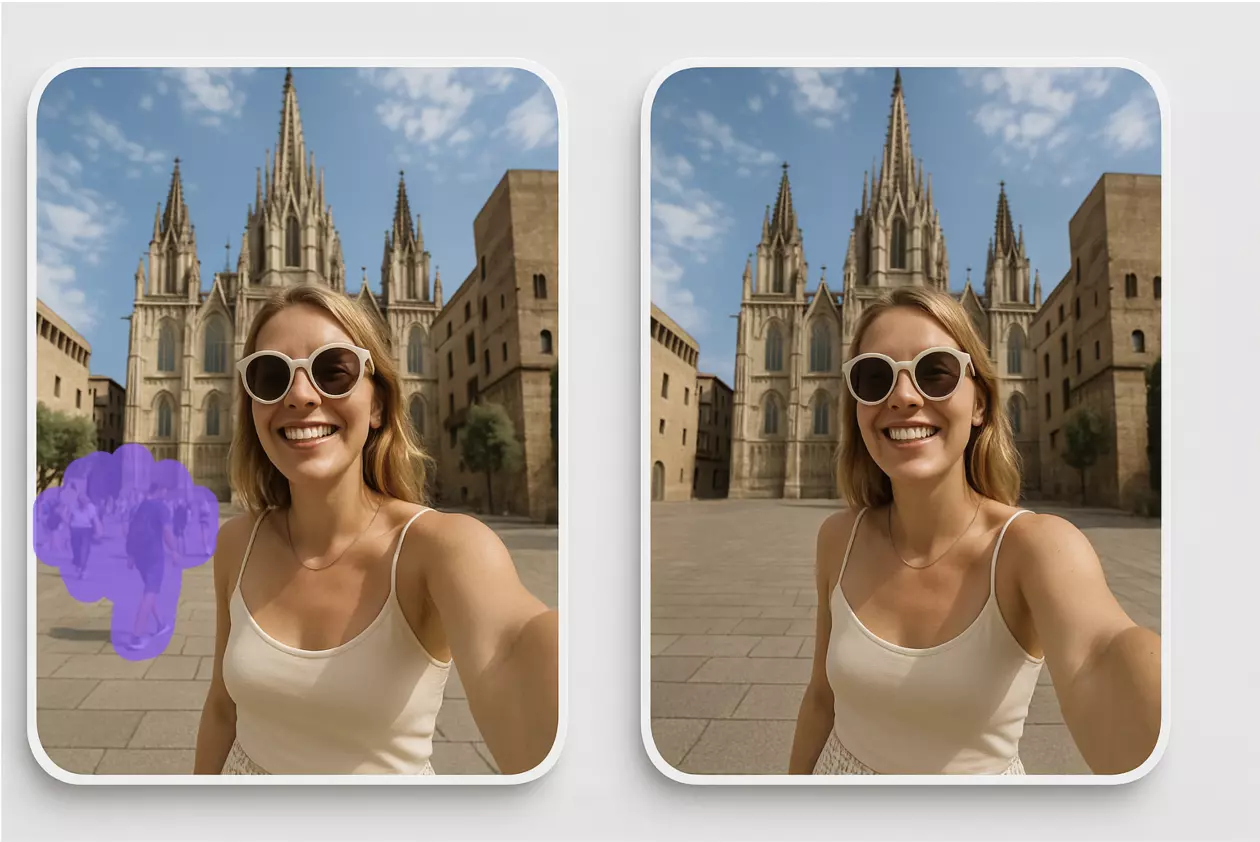
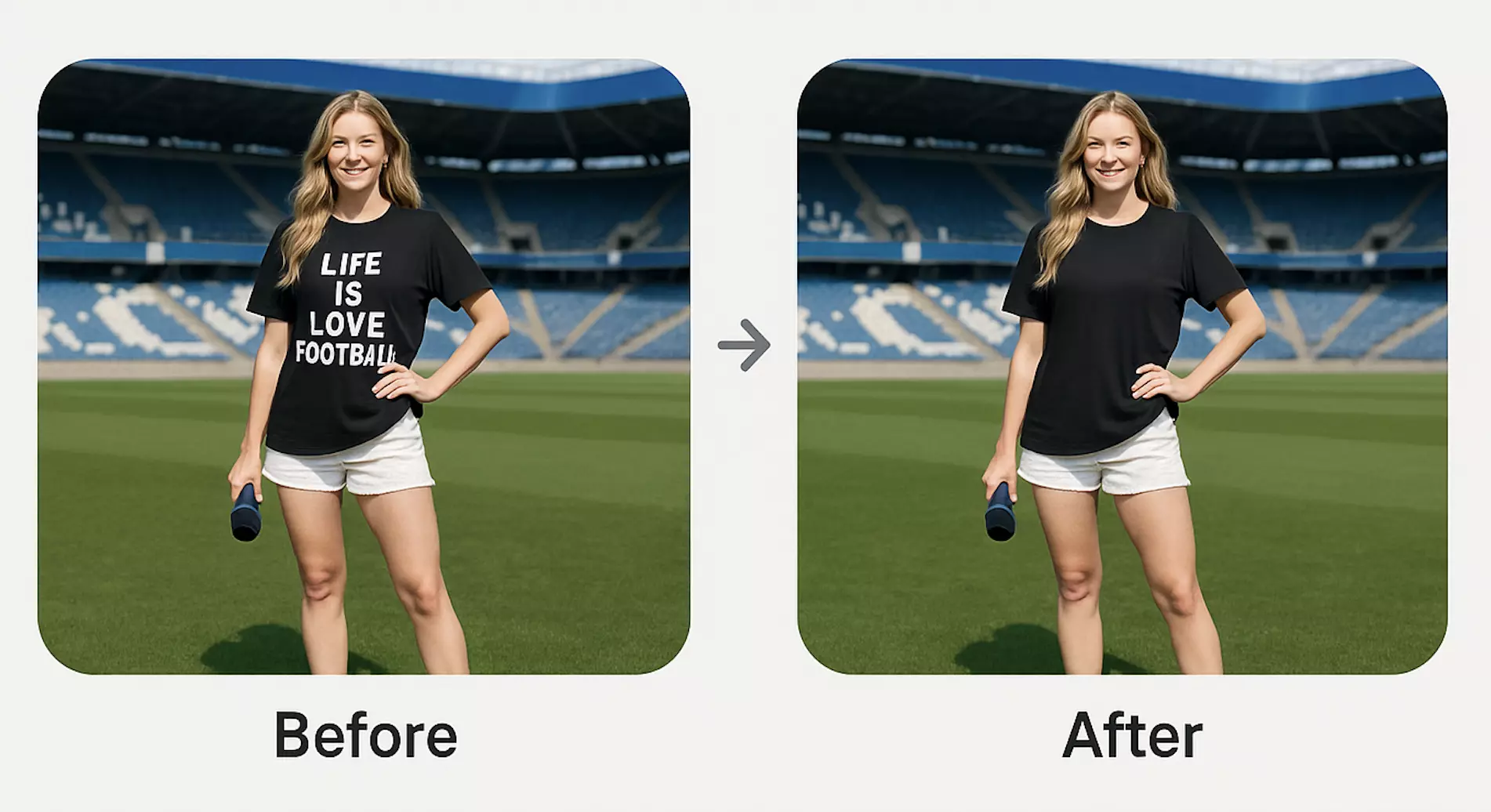
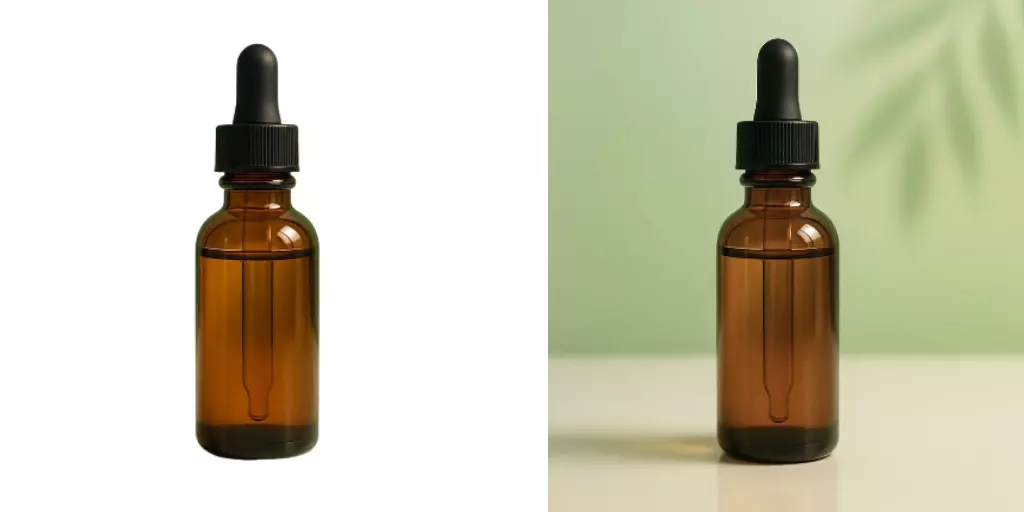
(See image: Before-and-after comparison of the same product with background removed, then changed to a neutral studio backdrop suitable for 3D spins.)
Visual principles for realism: depth, lighting, shadows, and segmentation
To sell immersion, focus on these four principles:
- Depth and perspective: A background with subtle depth cues (soft gradient or slight ground plane) helps the product “sit” in space instead of floating. For spins, you might add a faint contact shadow aligned with your hero angle.
- Lighting direction and color: Match your background’s illumination to the product’s key light. Warmer products look strange on icy-blue backdrops and vice versa. Keep your white balance consistent session to session.
- Shadow shape and softness: Hard-edged shadows scream “cutout.” Use soft, elliptical contact shadows that loosely mirror the object’s footprint. The blur radius should correlate with the perceived distance to the surface.
- Clean segmentation: Edges should be crisp but not harsh. Watch for halos around high-contrast areas (white footwear on dark gray, chrome edges on white) and refine if you see fringe or color spill.
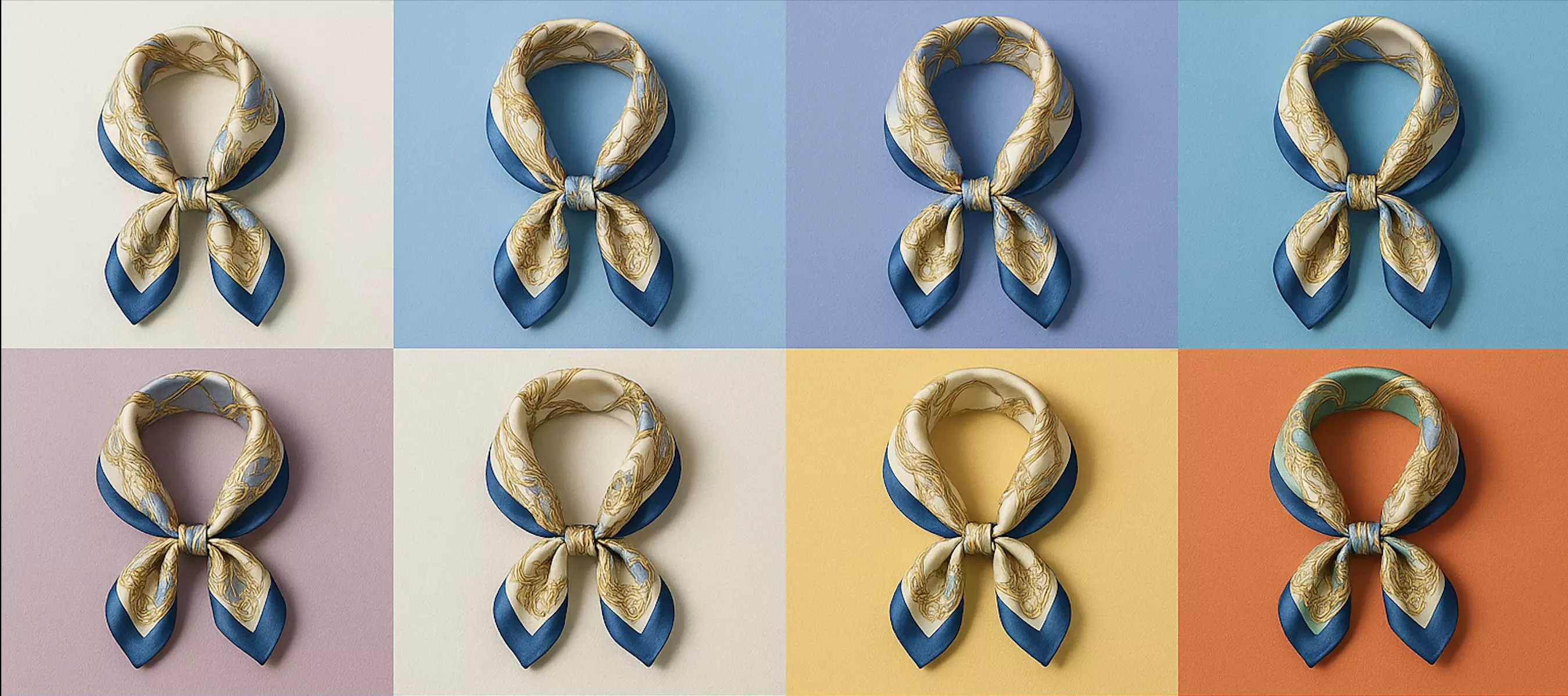
(See image: AR try-on preview grid demonstrating consistent background, matched lighting, and soft contact shadows across variants.)
When to remove, change, or generate new backgrounds
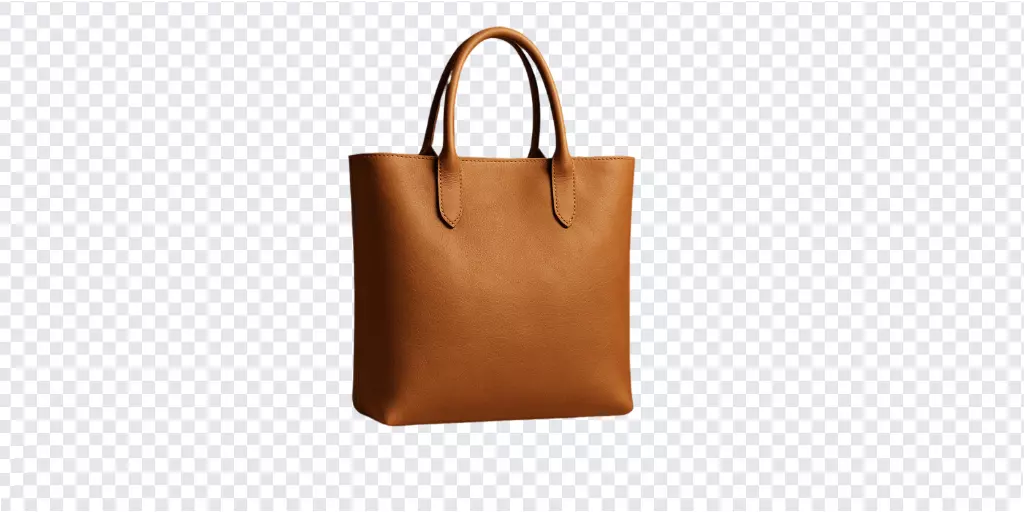
- Remove: Use a pure removal when your product will be composited into a standardized studio backdrop or a marketplace template. This is common for listings where 3D spins require uniformly neutral environments.
- Change: If you already have acceptable product lighting but a distracting set, replace the original with a neutral or branded background. Keep luminance and color temperature aligned to avoid “cutout” cues.
- Generate: For campaign imagery or lifestyle product pages, generate a new, brand-true scene that supports the product context (e.g., a modern kitchen for small appliances). Keep it restrained; realism beats spectacle for conversion.
Compliance tip: If you plan to remove watermarks or logos, only do so when you own the rights or have explicit permission. AI watermark removal is powerful, but it must not be used to bypass copyright, licensing, or marketplace disclosure rules.
(See image: Pixflux.AI interface showing the three-step flow: upload, AI processing, and download for a product photo background change.)
Source image preparation for 3D and AR pipelines: resolution, angles, and lighting
Good inputs make background edits faster and more accurate:
- Resolution: Aim for 2000–3000 px on the long edge for catalog spins, higher for hero SKUs. For AR, prioritize sharpness around edges; small edge details like laces or hair demand more pixels.
- Angles and coverage: For 3D spins, capture consistent increments (e.g., 24 or 36 angles) on a turntable. Keep the height and camera distance locked. For AR try-ons, ensure anchor-friendly views (front, three-quarter, side) and maintain scale relationships.
- Lighting: Use a soft key and fill, plus minimal specular hotspots. Keep color temperature fixed across the set. Place neutral cards for quick color checks.
- Background choice at capture: Even if you plan to change backgrounds later, shoot against a clean, low-texture backdrop to make segmentation simpler and cleaner.
- Keep it consistent: Document your setup and reuse it. Consistency is the cheat code for accurate masks and realistic composites.
How to change backgrounds with Pixflux.AI in three steps
Pixflux.AI makes it simple to standardize product photos for 3D/AR use while preserving materials and color.
- Upload your source images
- Drag and drop product shots, or select files from your computer. For multi-SKU updates, batch upload to accelerate processing.
- Let the AI process the background
- Choose removal or replacement, then apply a neutral studio backdrop or an on-brand color/gradient. Maintain consistent lighting direction when selecting new backgrounds. If you’re ready to try it now, head to change image backgrounds.
- Download the updated images
- Review the output, then export in your preferred format (e.g., PNG with transparency for later compositing or JPEG/WebP for immediate use on PDPs).
Advanced option: If you need granular control (edge refinement, shadow tuning), run a detailed pass, preview, make small adjustments, and re-run on your final settings. Repeatability beats perfection on the first try.
Quality benchmarks and metrics for 3D/AR-ready product photos
Define clear, objective acceptance criteria:
- Mask quality: Aim for high IoU with manual masks and watch edge width (<2–3 px halos at 100% zoom).
- Color fidelity: Keep ΔE color differences minimal after compositing; avoid hue shift on whites, metallics, and skin tones.
- Shadow realism: Soft contact shadow, aligned with product base, blur radius proportional to scale. No double-shadow artifacts.
- Background spec: Neutral, low-contrast gray/near-white (#F3–#FA range works well). Avoid hard gradients or textures for 360 spins.
- File format and weight: PNG for transparency; WebP or high-quality JPEG for listings. Keep file sizes lean without sacrificing detail.
- Consistency set-to-set: Uniform angle framing, horizon line, and illumination across SKUs and variants.
Batch processing and version control for multi-SKU catalogs
At scale, time is won or lost in workflow, not just tooling:
- Batch passes: Use Pixflux.AI to process sets of images in one go—apply the same background and shadow logic to every angle and SKU to lock in consistency.
- Naming: Adopt predictable patterns (SKU_view_angle_variant_v1) to keep spins and AR assets synchronized.
- Versioning: Save v1 (raw removal), v2 (neutral studio), v3 (campaign scene). Keep a change log of background specs (color, gradient, shadow strength).
- Review gates: Spot-check edge cases—translucent packaging, chrome, and fine textiles—before publishing the whole batch.
This approach shrinks turnaround for seasonal refreshes and multi-vendor onboarding cycles, where an AI pass can unify a patchwork of source quality into a coherent catalog.
Risk, copyright, and disclosure in edited product imagery
- Copyright and licensing: Only modify images you own or are licensed to edit. Removing watermarks or logos from third-party images without permission may violate terms and laws.
- Platform rules: Marketplaces (e.g., Amazon, Walmart, Target) define background standards and disclosure expectations. If you generate lifestyle scenes, follow the listing guidelines and avoid misrepresenting product scale or features.
- Truth in visuals: Keep edits realistic—do not alter product attributes (colorways, features) that could mislead. Background changes should clarify, not distort.
Troubleshooting artifacts: halos, mismatched shadows, metal and transparent surfaces
- Halos on high-contrast edges: Re-run the edit with slightly softer edge handling, or adjust feathering. Check source lighting—overly bright edges cause blooming that reads as fringe.
- Mismatched shadows: If the product lighting suggests a left-sided key light, ensure the new background shadow follows that direction. Add a subtle contact shadow to “seat” the product.
- Metallic finishes: Chrome and polished metal reflect the environment. If you’re compositing into a neutral studio, slight reflection taming can help; keep highlights but avoid blue/green casts.
- Transparent and translucent materials: Ensure the background color doesn’t tint the product. Consider a neutral gray backdrop to minimize color bleed.
- Banding in gradients: Use 16-bit edits before export or choose higher-quality compression to avoid posterization on soft studio gradients.
AI tools vs traditional methods
- Time to value: A browser-based AI editor like Pixflux.AI gets you from messy source images to consistent PDP-ready assets in minutes. Traditional tools (Photoshop with manual masking) are powerful but slow, especially under deadlines.
- Learning curve: Teams can align quickly on a simple three-step flow rather than training every contributor on advanced selection and compositing techniques.
- Batch throughput: AI shines when you need to clean and standardize angles across dozens of SKUs, or refresh seasonal colorways fast.
- Cross-team alignment: Creative, merchandising, and DTC teams can work from the same visual spec sheet without reinventing the wheel per product.
Pixflux.AI won’t replace expert retouching for hero campaigns, but for 80% of catalog images—especially 3D spins and AR-ready listings—an AI pass delivers consistent, brand-faithful results at speed.
FAQ: Background editing for 3D spins, AR try-ons, and ecommerce imagery
What background color works best for 3D spins?
A neutral, low-contrast gray or near-white works best. Soft gradients and subtle contact shadows help the product sit in space without stealing attention. Keep the hue and luminance consistent across every angle and SKU to avoid flicker during spins.
Can I use edited images for AR try-ons on major marketplaces?
Yes, as long as your assets meet each marketplace’s image standards and disclosure rules. Follow platform requirements for background color, image dimensions, and realism. If you generate lifestyle scenes, ensure they don’t misrepresent size, features, or context. When in doubt, publish a studio-style version for compliance and a lifestyle variant for PDP enrichment.
How do I avoid halos around hair, laces, or transparent plastics?
Start with high-resolution sources and consistent lighting, then refine edges if you see fringing. Harsh rim lights create bloom that reads as a halo after removal. Shoot against a clean backdrop, reduce overexposed edges, and use an AI editor that preserves fine detail. If needed, re-run the pass with gentler edge smoothing and check shadows against the background.
Does changing backgrounds affect color accuracy of the product?
It shouldn’t, if you maintain proper white balance and avoid color spill. Use a neutral backdrop and verify color with swatches or a gray card during capture. If your product appears shifted after compositing, check the background hue and adjust white balance to preserve true product color.
How many images can I process at once with an AI editor?
You can batch multiple images to speed up catalog updates. Batch processing applies consistent removal and replacement across a set—ideal for 24–36 spin angles or multi-variant colorways. Always spot-check edge cases (metallics, translucent parts) before publishing.
Can I remove watermarks or logos from product photos?
Only if you own the rights or have permission to do so. Even if technically feasible, removing third-party watermarks without authorization may violate copyrights, licenses, or marketplace policies. Use watermark removal strictly for assets you’re legally allowed to modify.
What resolution and aspect ratio should I use for 3D/AR-ready product images?
Target 2000–3000 px on the long edge with square (1:1) or vertical-friendly (4:5) crops for PDPs. For AR pipelines, prioritize crisp edges and well-exposed details. Keep framing consistent across angles and variants to stabilize your spins and ensure accurate AR scale.
Conclusion and next steps
Immersive shopping raises the bar on product imagery. Clean, consistent backgrounds aren’t cosmetic—they’re the backbone of convincing 3D spins and AR try-ons. Standardize your visual spec, prepare solid source images, and use a fast, reliable AI editor to do the heavy lifting at scale.
Ready to make your catalog AR- and 3D-ready? Try Pixflux.AI as your go-to background changer for product photos and turn inconsistent sets into conversion-ready assets in minutes.