Photo Background Remover for UGC-to-Listing: Turn Creator Shots into Storefront-Ready Images
Tired of messy creator photos? See how to isolate products, keep natural shadows, and auto-export clean sizes for PDPs, ads, and marketplaces.
 Richard SullivanJanuary 21, 2026
Photo Background Remover for UGC-to-Listing: Turn Creator Shots into Storefront-Ready Images
If you rely on creator content to populate your product detail pages, you already know the pain: bright, authentic UGC shows the product in real life—but cluttered rooms, mixed lighting, and inconsistent backgrounds break visual consistency across your catalog. Conversion dips. Marketplaces push back on non-compliant images. Ad performance becomes unpredictable.
The fix isn’t “stop using UGC.” It’s standardizing UGC into listing-ready visuals with a fast, accurate photo background remover that isolates the product, preserves natural shadows, and outputs clean crops for PDPs, ads, and marketplaces. Tools like Pixflux.AI streamline this step so teams can get from creator shots to publishable assets in minutes. If you’re new to this workflow, start with a modern photo background remover and build your process around it.
(See image: Before-and-after of a creator-shot sneaker—cluttered room to clean white background with natural shadow preserved.)
Why UGC-to-Listing Fails Without Consistent Backgrounds
- Mixed backgrounds break brand coherence: UGC shot in kitchens, gyms, or bedrooms introduces visual noise that distracts from the product.
- Inconsistent lighting hides details: Hard shadows and color casts lower perceived quality and introduce return risk.
- Marketplace compliance gets tricky: Amazon, Walmart, and other US/global marketplaces tighten rules on background colors, margins, and props. Non-compliant images get suppressed.
- Multi-channel demands fragment workflows: PDP, social ads, marketplaces, and discovery surfaces prefer different aspect ratios. Inconsistent inputs multiply editing work.
Industry trend: retailers now demand studio-like consistency from creator content because predictable visuals protect conversion rates. Meanwhile, AI background removal rivals manual masking for edge fidelity and speed—making UGC standardization practical at scale.
Key Principles: Isolate the Product, Preserve Natural Shadows, Unify Lighting
- Isolate the product: Accurately cut out the item so edges (laces, hair, translucent glass, jewelry prongs) remain crisp without halos.
- Preserve natural shadows: Keep believable contact shadows or add soft ones to avoid a cut-and-paste look. Shadows ground products and improve depth perception.
- Unify lighting: Normalize exposure and color so the product looks the same across variations, even when source photos vary.
- Standardize backgrounds: Use a neutral solid (white, very light gray, brand-specific neutral) to keep attention on the product and simplify compliance.
Marketplace and PDP Requirements: Background Colors, Margins, and Aspect Ratios
While specifics vary, these guardrails cover most US/global platforms:
- Background color: Pure white (#FFFFFF) or a very light neutral for main images on many marketplaces. Lifestyle images can use contextual backgrounds if allowed.
- Margins and product fill: Aim for 80–90% product coverage within frame without cropping off key features. Leave consistent padding for thumbnails.
- Prohibited elements: No logos, badges, watermarks, heavy reflections, or distracting props in main images.
- Aspect ratios:
- 1:1 (square) for most marketplace mains and PDP galleries.
- 4:5 (vertical) for social and ad placements.
- 16:9 (horizontal) for hero banners and widescreen surfaces.
- Resolution and file size: Keep high-resolution masters; export web-ready JPEG/PNG under marketplace size caps to avoid compression artifacts.
Choosing a Photo Background Remover: Online vs Desktop, Accuracy and Speed
Evaluate on:
- Edge fidelity: Fine hair, transparent materials, thin straps, and complex contours should survive the cutout without jagged edges.
- Shadow handling: Option to preserve or rebuild natural shadows.
- Speed and batch capability: Turn sets quickly; batch processing shortens time-to-publish.
- Accessibility: Online tools like Pixflux.AI require no installs and work across teams; desktop editors are powerful but slower for non-experts.
- Output control: Clean exports that adapt to 1:1, 4:5, and 16:9 with consistent margins.
If you need rapid UGC-to-listing workflows, an online background remover with reliable edge detection and batch handling usually wins on time-to-value.
Workflow: Standardize UGC with a Photo Background Remover (Step-by-Step)
- Collect and score UGC: Choose shots with sharp focus, unclipped highlights, and full product visibility.
- Remove distractions: Use a background remover to isolate the product and keep natural shadows when possible.
- Normalize the background: Apply a white or brand-neutral background; maintain consistent padding across images.
- Enhance essentials: Increase clarity, contrast, and true-to-life color; fix minor color casts caused by mixed lighting.
- Export for channels: Produce 1:1 for marketplaces/PDP, 4:5 for social ads, and 16:9 for banners. Recheck margins and file size.
When you’re ready to try this flow end-to-end, open a background remover for product photos and follow the steps below with Pixflux.AI.
Standardize UGC with Pixflux.AI: Background Removal, Shadow Preservation, and 3-Step Export
Use Pixflux.AI to turn creator shots into clean, consistent product page images with a fast three-step path:
- Upload your original image
- Drag and drop the UGC photo into Pixflux.AI. Start with the highest resolution available for better edges and textures.
- Let the AI remove the background
- The background is cut away while the subject is isolated. Keep natural shadows for realism, or opt for a clean base if you’ll add a soft drop shadow later.
- Download your cleaned image
- Save the processed PNG/JPEG and create your 1:1, 4:5, and 16:9 crops while maintaining the same background color and product padding.
(See image: Pixflux.AI interface showing the 3-step flow—upload image, AI processes, download result.)
Tip: Use neutral backgrounds and consistent margins across all aspect ratios so your PDP and ad variants look like a cohesive set rather than unrelated edits.
Advanced Edits: Change or Generate Brand-Consistent Backgrounds Without Artifacts
Sometimes white isn’t enough. Seasonal campaigns, premium categories, or DTC brand playbooks may call for subtle gradients or textured neutrals. With Pixflux.AI, you can:
- Replace backgrounds to match a brand palette without introducing color bleed.
- Generate new, on-brand backdrops that keep the product dominant and free of artifacts.
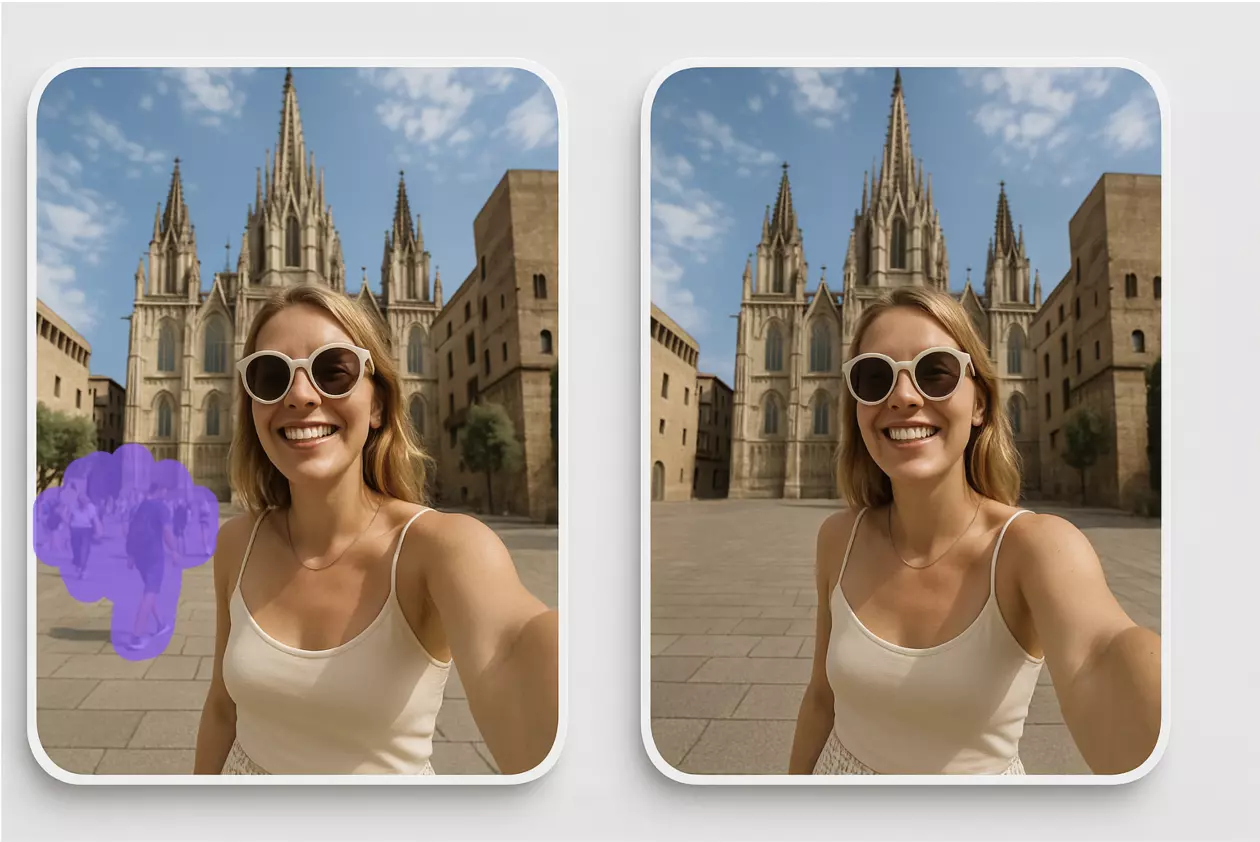
- Remove stray objects (e.g., cables, passerby reflections) that survived the initial cutout.
- Enhance clarity and contrast to recover details lost to low light.
Five-step advanced workflow with Pixflux.AI:
- Open Pixflux.AI and upload your UGC image
- Choose background removal and run the cutout
- Change or generate a brand-consistent background; keep or reintroduce soft shadows
- Fine-tune edges, fix color casts, and remove any leftover distracting objects
- Download and produce your required aspect ratio exports
Compliance note: Only remove watermarks or logos from images you own or are licensed to edit. Watermark removal must not be used to bypass rights management or platform rules.
(See image: One product photo exported into 1:1, 4:5, and 16:9 crops on neutral backgrounds ready for PDP, ads, and marketplace listings.)
Batch Processing UGC Sets for Ads, PDP, and Marketplaces
If you receive UGC in volume, batching is essential:
- Group by product or SKU: Process all angles of one product together to ensure lighting and background consistency.
- Batch upload and process: In Pixflux.AI, upload multiple images in one go and apply the same background and shadow settings across the set.
- Standardize margins: Use a single visual rule (e.g., product fills 85% of the frame) and apply it to all aspect ratios.
- Naming and versions: Append suffixes like _SQ, _45, _169 to filenames for fast routing to PDP, social ads, and hero modules.
- Quick QA pass: Check edges on hairlines, glass reflections, and metallic surfaces before publishing.
Quality Checks: Edges, Hair, Reflections, Color Cast, and Compression
Before you export and publish:
- Edges and halos: Zoom to 200% and look for jagged outlines or light halos around dark products; re-run refine if needed.
- Hair and fine details: Ensure strands, laces, and stitching remain visible without smudging.
- Transparent and reflective materials: Verify glass and metal keep believable reflections without odd cut lines.
- Natural shadows: Confirm the shadow direction matches lighting and doesn’t look pasted on.
- Color cast correction: Neutralize warm (tungsten) or green (fluorescent) casts to keep the product accurate.
- Compression and artifacts: Export at web-appropriate sizes without over-compressing. Artifacts are especially visible on gradients and text labels.
Compliance and Ethics: Rights, Watermarks, and Disclosure
- Rights and permissions: Only edit and publish images you own or have explicit permission to use from creators. Secure licenses for paid placements.
- Watermark and logo removal: Use this capability only to clean your own branded assets or with documented permission. Do not remove third-party watermarks to evade attribution.
- Disclosure: If you modify creator content materially for ads, follow your market’s disclosure standards and platform advertising policies.
AI Online Tools vs Traditional Methods
- Time cost: Online tools like Pixflux.AI remove backgrounds in seconds; manual pen paths in desktop software can take 10–20 minutes per image, longer for hair or glass.
- Learning curve: Non-designers can produce listing-ready outputs with minimal training; pro editors still benefit for speed on routine work.
- Batch efficiency: Batch uploading and one-click consistency settings accelerate large UGC sets; traditional workflows often require per-file repetitive steps.
- Cross-team adoption: Browser-based access fits marketing, marketplace, and creative teams without software installs or steep onboarding.
- Creative control: Desktop tools excel in complex composites; for everyday UGC-to-listing conversions, AI background removal now offers comparable edge quality with far less effort.
FAQ: Background Removal for Product Photos, Shadows, and Multi-Size Output
What background color should I use for product listings?
Use pure white or a very light neutral for main listing images. Most marketplaces prefer white (#FFFFFF) for mains to ensure catalog uniformity, while lifestyle images can use contextual backgrounds when policy allows. Keep your PDP and ad variants consistent to avoid visual fragmentation.
How do I keep natural shadows when I remove the background?
Choose a tool that preserves contact shadows during the cutout. Natural shadows anchor the product and prevent a “sticker” look. In Pixflux.AI, you can retain existing shadows or add a subtle soft shadow after removal for realism.
Can I process multiple UGC images at once?
Yes, batch processing shortens turnaround and improves consistency. Upload a set, apply the same background and padding rules, and export as a group. Pixflux.AI supports batch handling so your 1:1, 4:5, and 16:9 derivatives stay visually aligned.
Will background removal reduce image quality?
No, not if you start with high-res inputs and avoid over-compression on export. Modern AI preserves edges and fine details; export PNG/JPEG at sufficient resolution and inspect at 100–200% to catch artifacts before publishing.
How do I create multiple aspect ratios from one product photo?
Cut out once, then produce 1:1, 4:5, and 16:9 crops while keeping margins consistent. Maintain the same background color, padding, and shadow logic across all crops so the set feels cohesive across PDP, ads, and marketplace placements.
Is it legal to remove watermarks from images?
Only when you own the asset or have explicit permission. Watermark removal must not be used to strip rights management from third-party images or violate platform policies. Document permissions from creators for edited content.
What’s the difference between an online photo background remover and desktop editing?
Online tools excel at speed and ease; desktop editors offer deep manual control. For UGC-to-listing workflows at scale, AI background removal in the browser provides near–studio quality with minimal effort, while desktop apps remain valuable for complex composites and retouching.
Conclusion and Next Steps
Clean, consistent backgrounds turn creator shots into storefront-ready assets that convert. With AI now matching manual masking for edge quality—and retailers and marketplaces tightening standards—the winning workflow is clear: isolate the product, preserve natural shadows, unify lighting, and export reliable crops for every channel.
Start now with Pixflux.AI and quickly remove backgrounds from UGC images to build PDP, ad, and marketplace visuals that look like they came from the same studio—without slowing your team down.