How to Remove Text from an Image Without Losing Quality
Erase unwanted words without wrecking pixels. Follow non-destructive steps and try Pixflux.AI for fast, high-quality text cleanup.
 Richard SullivanSeptember 13, 2025
.png?tr=w-1200,h-600,c-maintain_ratio,q-90,f-webp)
How to Remove Text from an Image Without Losing Quality
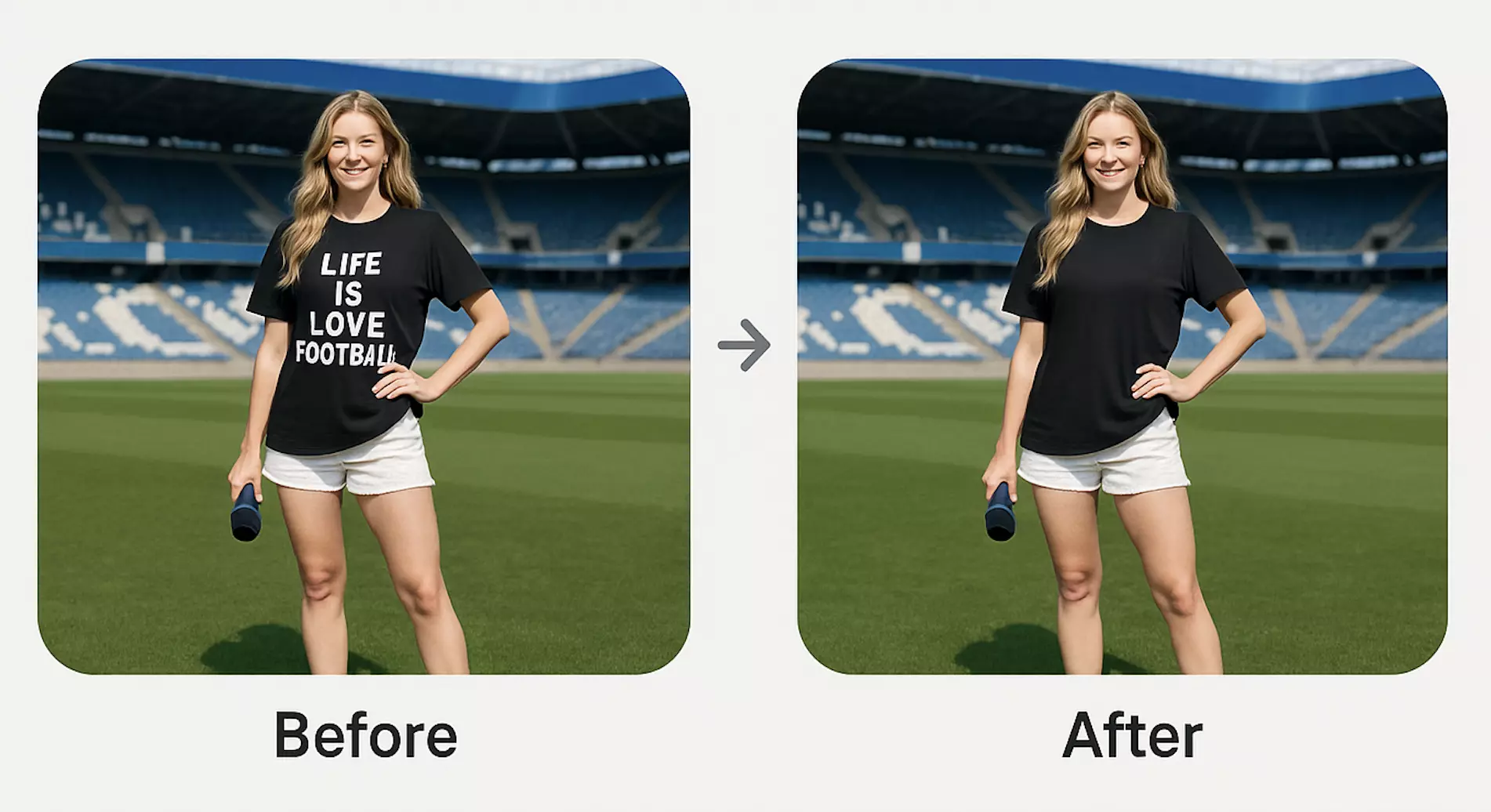
You snap a great product shot, only to realize there’s a price tag overlay in the corner. Or you receive a branded asset but need the title gone for an A/B test. Removing text is easy to do badly: edges smear, textures warp, and viewers instantly notice something’s off. Doing it well means preserving texture, lighting, and resolution as if the text was never there.
Today’s browser-based inpainting tools rival desktop software for everyday edits. If you want fast results without wrestling with complex settings, AI object removal can help you remove text cleanly. Tools like Pixflux.AI make it straightforward to remove text from image while keeping surfaces, grain, and gradients intact.
(See image suggestion: Before-and-after comparison showing text removed from a textured wall while preserving grain and lighting.)
Why “remove text without losing quality” is trickier than it looks
Text blocks often cut across edges, textures, and gradients:
- Edges: Type that sits on a seam, carton corner, or horizon creates distinct geometry that must continue seamlessly after removal.
- Textures: Walls, fabrics, and brushed metal have repetitive but not perfectly uniform patterns. Bad fills create repeating tiles and blur.
- Gradients: Sky, shadows, and studio backdrops require consistent luminance. Poor inpainting produces banding or halos.
Quality removal means the fill respects surrounding structure, texture frequency, and lighting direction. That’s why a simple blur or a quick clone rarely passes a 100% zoom inspection.
Methods compared: clone/heal, content-aware fill, and AI object remover
- Clone/Heal tools
- Best for: small type on uniform textures.
- Pros: full control, works offline.
- Cons: slow on complex backgrounds; easy to introduce repeated patterns or mismatched lighting.
- Content-Aware Fill (and similar inpainting techniques)
- Best for: medium-sized text with clear surrounding texture to sample.
- Pros: fast, context-aware.
- Cons: can smear edges, mirror artifacts, or band gradients. Often needs manual cleanup.
- AI object remover
- Best for: most day-to-day removals across varied textures.
- Pros: learns structure and texture continuity, handles tricky edges and gradients, fast, beginner-friendly.
- Cons: may require a few retries on ultra-complex scenes or curved, glossy surfaces.
Prepare your file for maximum fidelity
Before you erase text from a photo, set yourself up for success:
- Start from the highest-resolution version you have. If you shot it, use the original or a high-quality export; smartphone RAW capture delivers cleaner textures.
- Work non-destructively: save a copy and keep layers where possible.
- Avoid aggressive compression during export; artifacts make fills less natural.
- Normalize exposure and white balance first. Stable lighting improves inpainting results.
Non-destructive workflow: masks and layers
If you’re using desktop software, try this layer-based approach to preserve control:
- Duplicate the background layer. Keep the original hidden as a safety.
- Make a loose selection of the text area. Feather 2–5 px to avoid hard seams.
- Run Content-Aware Fill (or patch/heal) on the selection. Inspect at 100% zoom.
- Add a soft-edged layer mask to reveal/hide parts of the fill where needed.
- Tidy edges with a small Healing Brush. Match brush hardness to the surface: softer for fabric, harder for metal or sharp edges.
- For patterned textures, sample across seams and vary your source points to avoid visible repeats.
- Use low-opacity clone strokes for micro-adjustments—short, directional dabs following the texture grain.
(See image suggestion: 100% zoom crop illustrating edge fidelity after inpainting versus the original text area.)
How to remove text from an image with Pixflux.AI
When you want a clean, reliable result without the manual overhead, Pixflux.AI’s AI object remover streamlines the process. Here’s the quick three-step workflow:
- Upload your image
- Drag and drop your photo into Pixflux.AI.
- Let the AI process
- Highlight or indicate the text area. The AI analyzes structure, texture, and lighting to inpaint naturally.
- Download the result
- Preview at 100% zoom, make any minor adjustments, then export your final image.
If you’re ready to try it now, you can use Pixflux.AI to erase text from a picture in minutes.
Advanced five-step variant for picky edits:
- Open Pixflux.AI in your browser.
- Upload the highest-resolution version of your image.
- Choose the object/text remover tool and run the AI pass.
- Inspect edges, gradients, and patterns; fine-tune with guided adjustments if needed.
- Download the processed image in your preferred format.
(See image suggestion: Pixflux.AI interface showing the three-step workflow: Upload → AI process → Download.)
Ethical editing: watermarks, labels, and platform policies
Remove only text you have the rights or permission to modify. Do not use text or watermark removal to infringe copyrights, bypass licenses, or violate marketplace and social media policies. Many platforms in the US and globally are tightening rules around watermark removal; when in doubt, seek permission or source licensed, unwatermarked assets.
Parameter guide: brush size, sampling, feathering, texture consistency
Whether you’re in desktop software or fine-tuning an AI pass, these settings influence quality:
- Brush size
- Keep the brush slightly larger than the text stroke width for heals; reduce size near edges to avoid overreach.
- Sampling strategy
- Clone from nearby areas with matching angle and lighting. Rotate sampling direction along fabric weave or wood grain.
- Feathering
- Feather selections 2–8 px depending on resolution; higher-res images can take a wider feather for smooth transitions.
- Texture consistency
- Align your edits with the texture frequency. For fine-grain surfaces, prefer smaller, varied strokes; for broad gradients, use larger, softly blended fills.
Quality checks: what to inspect before you export
Do a quick preflight at 100% zoom:
- Edges
- Corners, borders, and seams must remain straight and continuous.
- Patterns
- No tiled repeats or mirrored motifs where text used to be.
- Banding
- Gradients (sky, studio backdrops) should be smooth; add subtle noise if needed to break banding.
- Noise and sharpness
- Match the surrounding luminance and grain so the patch doesn’t pop out.
- Color and exposure
- Ensure the filled region doesn’t shift warmer/cooler relative to the scene.
Batch cleanup for product photos with Pixflux.AI
For ecommerce sellers on Amazon, Etsy, or eBay, cleaning a catalog one file at a time is a bottleneck. Pixflux.AI supports batch processing so you can:
- Upload multiple images together.
- Remove recurring labels or promotional text across a full set in one go.
- Apply consistent cleanup to maintain brand look across thumbnails and PDP images.
This is especially effective for:
- Purging outdated price overlays across seasonal campaigns.
- Tidying supplier-provided photos that include SKU stamps or stickers.
- Standardizing hero images for marketplace compliance.
Browser-based pipelines like this help teams ship updates faster without sharing large project files or specialized software on every device.
Troubleshooting artifacts: smudges, repeats, gradients, curves
- Smudges on textured surfaces
- Reduce brush size; re-sample frequently; follow grain direction with short strokes.
- Repeating tiles
- Offset your sampling area; introduce variation by sampling from multiple points; rotate pattern direction subtly.
- Gradient banding
- Add a tiny amount of noise or grain to the filled area; consider a gentle gradient overlay at low opacity to match falloff.
- Curved, glossy surfaces
- Reconstruct reflections consistent with the curve; use multiple small fills rather than one large one; consider a secondary AI pass with a tighter selection.
AI online tools vs. traditional software or outsourcing
- Time cost
- Traditional: 5–20 minutes per image for careful clone/heal work; longer for complex textures.
- AI: often under 1–2 minutes per image, plus quick visual checks.
- Learning curve
- Traditional: strong retouching skills required to maintain texture fidelity.
- AI: beginner-friendly; focus on selection and result review.
- Batch efficiency
- Traditional: manual repetition across sets; error-prone.
- AI: upload multiple images and process them together for consistent results.
- Team agility
- Traditional: requires licenses and trained editors on every machine.
- AI: runs in the browser; non-design teammates can handle quick text removals when needed.
Trend watch: why this matters now
- Ecommerce marketplaces increasingly reward distraction-free product images; fast, clean text removal improves click-through in crowded feeds.
- Browser-based inpainting has caught up for most day-to-day use cases, letting marketers and creators work from anywhere with predictable quality.
- With smartphone RAW and better mobile lenses, even on-the-go captures can be cleaned up at high fidelity.
Visual references to add to your article or documentation
- Before/after on a textured wall with lighting preserved.
- 100% zoom crop comparing inpainting quality in the text area vs. original surroundings.
- A Pixflux.AI screenshot showing Upload → AI process → Download.
Putting it all together
If you need a quick path to keep resolution and texture intact, AI removal is the most efficient starting point. For edge cases, combine it with light manual retouching and the parameter tips above. When speed and consistency matter—especially across product sets—Pixflux.AI keeps the workflow simple: upload, process, download.
To try it on your own image, head over to Pixflux.AI and remove words from photos in a few clicks.
Note on compliance: Only modify images you own or are licensed to edit. Do not remove watermarks or labels in ways that violate platform rules or copyright.