Remove Text from Image Online: A No-Designer Workflow for Social, Decks and PDFs
A quick, browser-only way to erase text cleanly—better than cropping or blurs—so your screenshots, slides, and PDFs look polished and trustworthy.
 Sierra CappelenDecember 10, 2025
Remove Text from Image Online: A No-Designer Workflow for Social, Decks and PDFs
When you need to share a slide export, a PDF page capture, or a quick screenshot in a report, the last thing you want is distracting labels, confidential snippets, or unnecessary annotations. Cropping ruins composition. Heavy blurs look unprofessional and erode trust. And if you’re not a designer with Photoshop muscle memory, this “simple fix” can eat hours.
Browser-based AI editing has caught up. In 2025, edge-aware inpainting tools can remove text and rebuild the background so it looks like it was never there—no desktop installs or steep learning curve. If you’re looking to remove text from image online without calling a designer, try an AI-powered approach such as an online image text remover to handle it in minutes.
Why “remove text from image online” matters for non-designers
- Teams move faster in the browser. Business users and students increasingly handle visual cleanup themselves, and they prefer simple web workflows over heavyweight software.
- Platforms reward clarity and trust. LinkedIn, X, and internal hubs (Notion, Confluence) favor crisp visuals. Over-blurring reduces credibility and engagement.
- Consistency beats quick hacks. Cropping and paint-over boxes create visual noise across decks and docs. AI reconstruction keeps the original layout intact.
Common use cases: screenshots, slide exports, and PDF page captures
- Screenshots for Slack or JIRA: Hide a user email, an IP address, or an on-page label while preserving UI elements.
- Slide exports for client decks: Remove a draft tagline, a watermark, or a placeholder note without reshuffling the layout.
- PDF page captures for proposals: Clean price tags, comment callouts, or confidential stamps while keeping background textures intact.
Compliance note: Only edit images you own or have permission to use. If you remove watermarks, do so only when you have rights; do not use watermark removal to infringe on copyright or bypass platform rules.
Cropping and blurring vs AI reconstruction: quality, consistency, and trust
- Quality: Simple crops break composition and can cut off important context. Blurs draw attention to what you’re hiding. AI inpainting reconstructs background patterns, gradients, and edges so the result looks native.
- Consistency: When you need to remove text across a set of images—say, a batch of slides—AI keeps the look consistent in color, lighting, and texture.
- Trust: Clean, unbroken visuals read as intentional rather than patched. That’s vital for client-facing decks and shareable social posts.
(See image: Comparison grid—crop/blur vs AI object removal on a PDF page capture, focusing on preserved textures and edges.)
How AI text/object removal works (inpainting, edge awareness, texture synthesis)
- Inpainting: The tool identifies the selected text region and “imagines” plausible content to fill the hole.
- Edge awareness: Good models align fills with nearby lines, borders, and UI components to avoid wobbling edges or halos.
- Texture synthesis: Backgrounds like paper grain, gradients, grids, and photo bokeh are recreated for continuity.
The upshot: Instead of covering the problem, AI rebuilds what should be there.
Choosing an online tool to remove text from images: privacy, speed, output quality
- Privacy and control: Prefer tools that handle uploads securely and let you preview before downloading.
- Speed: Browser-first tools should process a single image in seconds and support quick iteration.
- Output quality: Look for edge-aware results, high-resolution exports, and support for tricky patterns (grids, gradients, UI shadows).
- Practical extras: Batch processing for sets of slides, background cleanup when text overlaps a busy scene, and basic image enhancement to sharpen soft captures.
Remove text from image online with Pixflux.AI: upload → AI process → download
Pixflux.AI is an online editor that focuses on practical, production-ready results for text and object removal. It’s designed for non-designers: no timelines, no complex masks—just a guided workflow that preserves edges and textures.
Quick 3-step workflow:
- Upload your image. Drag a screenshot, slide export, or PDF capture into the browser.
- Let the AI process. Use the text/object remover to inpaint the selected area with edge-aware reconstruction.
- Download the cleaned image. Save at full resolution or export a web-friendly version.
When you’re ready to try it, open the remove text from image online tool and follow the steps below.
(See image: Pixflux.AI interface sequence showing upload → AI processing for text removal → download of the cleaned image.)
Step-by-step: remove text from a slide export online and restore background details
Detailed 5-step workflow in Pixflux.AI:
- Open the tool page. Head to Pixflux.AI and open the text/object remover.
- Upload your slide export. PNG or JPG works best; you can also upload a page capture from a PDF.
- Select the area with text. Brush over the label, watermark, or placeholder note. Keep a slight margin around the text for better reconstruction.
- Preview and refine. Run the removal. If edges or gridlines need a touch-up, slightly adjust the selection and re-apply. Use image enhancement to restore clarity if the slide is soft after compression.
- Download your result. Export at original size or choose a compressed version for email and chat.
Pro tips:
- For thin text on grids: Zoom in and use a smaller brush for precise selection.
- For overlapping shadows: Run removal first, then lightly enhance contrast to match surrounding areas.
- Batch sets: If you have multiple slides with similar overlays, process them in one session to keep look and tone consistent.
(See image: Side-by-side before–after of a slide screenshot where on-slide labels are removed and the background grid is reconstructed cleanly.)
Compliance reminder: Only remove watermarks or text from images you are licensed to edit. This workflow is for legitimate cleanup, not to misrepresent ownership or bypass usage rights.
Advanced fixes: watermarks, background changes, and photo enhancement
- Persistent watermarks: If a semi-transparent logo spans a patterned background, remove in passes—first the logo, then any faint residues. Pixflux.AI can also enhance micro-textures after removal so patterns don’t look “smudged.”
- Background tweaks: If text sits on a cluttered backdrop, remove the text first, then simplify the background using AI background modification for a cleaner social-ready look.
- Photo rescue: For camera photos with date stamps or signage, remove the stamp and then apply AI image enhancement to recover sharpness and contrast.
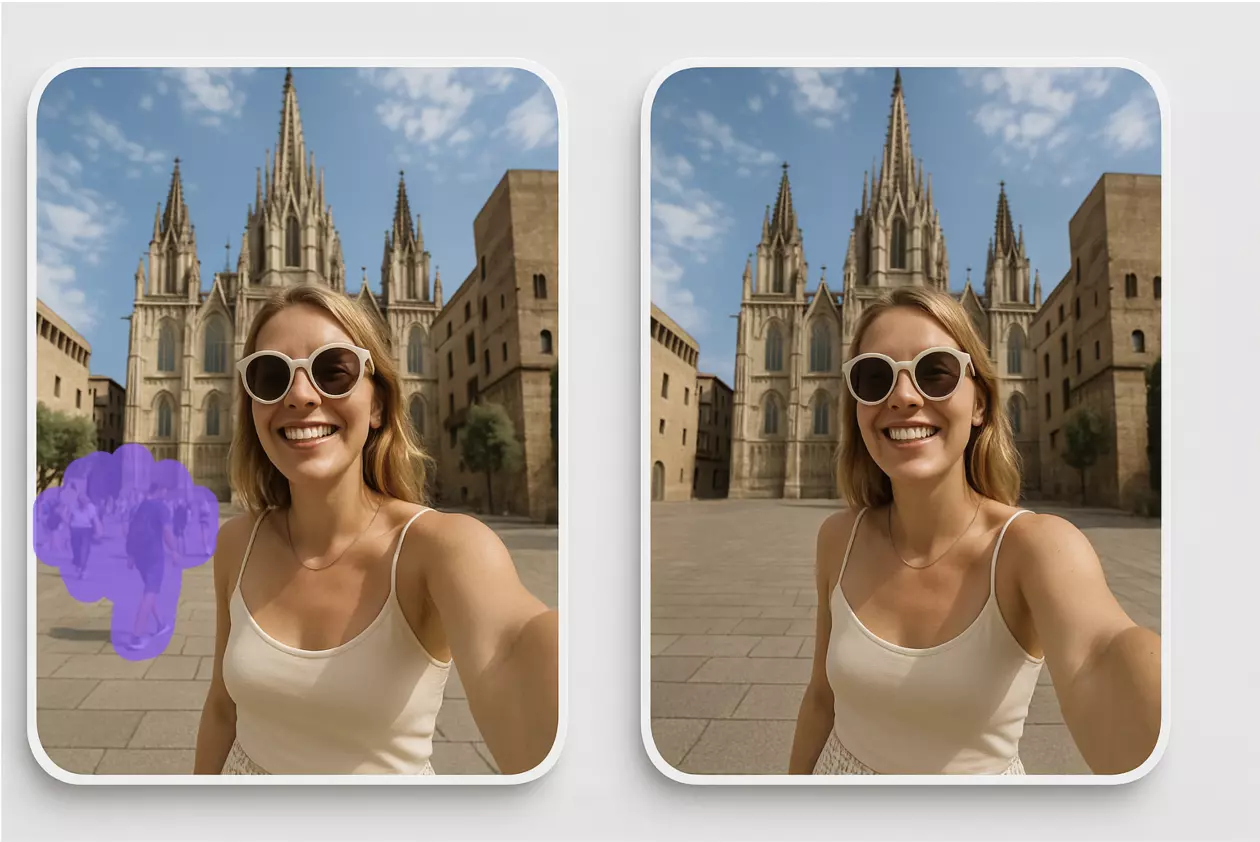
- Object distractions: Beyond text, eliminate extra objects like power lines, passerby silhouettes, or stickers that compete with your message—useful for marketing posts and marketplace listings.
Export presets for social posts, decks, and PDFs
- Social (LinkedIn, X, Instagram):
- Square (1080×1080), vertical (1080×1350), or landscape (1200×630).
- Use JPG at 80–85% quality for balance; PNG for UI-heavy images that need crisp lines.
- Slide decks (PowerPoint, Keynote, Google Slides):
- Maintain 16:9 at 1920×1080 or 2560×1440 for large screens.
- PNG preserves UI edges; consider light compression if emailing.
- PDFs and reports:
- Aim for 150–300 DPI depending on print or screen use.
- Keep file sizes manageable: JPG for photo-heavy, PNG for diagrams and UI.
Tip: After removal, glance at edges, gradients, and fonts. If colors shift slightly, apply a gentle overall contrast adjustment for uniformity.
Troubleshooting and guardrails: artifacts, complex patterns, and licensing rights
- Checkerboards and fine grids: If you see repeating patterns or “wobbly” lines after removal, tighten your selection and re-run; small, precise selections help the AI align textures.
- Strong gradients and shadows: Remove text first, then fine-tune with a subtle exposure/contrast nudge to blend the area.
- Repeated logos across a batch: Tackle representative images first to find the right brush size and approach, then repeat the technique across the set for consistency.
- Legal guardrails: Always confirm you have the right to edit the image. Removing logos/watermarks from third-party content without permission may violate terms or laws.
Before–after gallery and a professional quality checklist
Consider assembling a simple gallery for your team wiki so people can see what “good” looks like:
- Slide label removal on a grid background: clean lines, no haloing.
- PDF capture with a watermark: texture preserved, no smudge.
- UI screenshot with sensitive text: elements aligned, colors consistent.
Quality checklist:
- Edges: Are borders, icons, and gridlines straight and continuous?
- Texture: Do backgrounds (paper grain, gradients) look natural?
- Color: Any blocks that appear over-smoothed or mismatched?
- Readability: Is the focal content sharper and more trustworthy post-edit?
- Consistency: Do multiple images in a deck share the same finish?
AI online tools vs traditional methods
- Time cost:
- AI online: Minutes per image, seconds to iterate.
- Traditional desktop: Longer setup, heavier files; manual masking is slow.
- Outsourcing: Turnaround delays, back-and-forth feedback.
- Learning curve:
- AI online: Brush, preview, download.
- Traditional desktop: Layers, masks, content-aware fills; powerful but complex.
- Batch efficiency:
- AI online: Smooth for small-to-medium batches; quick repetition across similar slides.
- Traditional desktop: Powerful actions but requires setup and maintenance.
- Collaboration:
- AI online: Share links or results instantly in chat and docs.
- Traditional desktop: Larger files and version friction.
For teams that live in the browser, tools like Pixflux.AI hit the sweet spot: fast, predictable results without a design detour.
When to reach for Pixflux.AI specifically
Use Pixflux.AI when you need:
- Clean text removal with believable reconstruction for slides, screenshots, and PDFs.
- Quick touch-ups on product photos—remove a printed label, then refine the background for marketplace compliance.
- Batch cleanups for a set of marketing visuals in one sitting so the style stays consistent.
You can start directly in your browser using the online image text remover and complete the upload → process → download loop in minutes.
Conclusion and next steps
Clean visuals build trust, especially in decks, reports, and social posts. Instead of cropping away context or painting over with blur boxes, let AI handle the reconstruction so your image looks untouched. In 2025, lightweight web tools are replacing desktop editors for routine cleanup—and they’re finally good enough for professional work.
Give your team a reliable, no-designer workflow today. Open Pixflux.AI and remove text from pictures in browser to produce crisp, share-ready images that preserve layout, texture, and credibility.