Remove text from image for Presentation Assets: Clean Images Without Destroying Quality
Tired of captions and watermarks on your slides? See how AI inpainting (and a few pro tricks) clean images fast without artifacts.
 Sierra CappelenDecember 10, 2025
Remove Text from Image for Presentation Assets: Clean Images Without Destroying Quality
If you build slide decks, pitch visuals, or webinar assets, you’ve probably run into this: a perfect photo spoiled by a loud caption, a date-stamped screenshot, or a stock watermark you didn’t notice until you dropped it onto your master template. Cropping it out wrecks the composition. Blurring looks unprofessional. And manual retouching in a heavyweight editor can eat hours you don’t have.
Here’s the good news: AI inpainting now rivals expert manual retouching for text and logo removal, especially across gradients, fabric, wood, and other tricky textures. Instead of cloning pixels for every letter, you can let an online tool intelligently rebuild the scene behind the text—often in seconds. When you need to remove text from image without sacrificing quality, this approach is fast, consistent, and presentation-ready.
(Trend note: Teams are also standardizing quality metrics like SSIM and edge continuity to evaluate whether edits “hold up” on large screens. We’ll touch on that below.)
Why text-free visuals outperform in presentations
- Clarity and focus: Slide audiences have milliseconds to parse what they see. Removing labels or overlays that aren’t essential to the story reduces cognitive load.
- Brand consistency: Clean imagery aligns with your brand’s type hierarchy. Your slide typography should do the talking, not leftover captions baked into the photo.
- Accessibility: Screen-share compression exaggerates artifacts. A text-free image retains fidelity after video encoding.
- Reusability: A single clean master image adapts better across slide layouts, social posts, and web banners.
- Legal safety: Removing third-party text and watermarks from your own licensed assets avoids accidental attribution conflicts. Always ensure you have the right to edit.
What “remove text from image” really means: AI inpainting vs. manual cloning
- AI inpainting predicts the pixels that likely exist behind the text and synthesizes them to match nearby edges, lighting, and texture. It excels at complex patterns (brick, wood grain, bokeh) and gradients.
- Manual retouching (clone stamp, healing brush, content-aware fill) gives you surgical control—ideal for crisp geometric edges, technical UI screenshots, or when you need precise alignment with surrounding elements.
A hybrid mindset works best: use AI to handle 80–90% of the cleanup, then do quick manual touch-ups where straight lines, logos near edges, or repeating patterns need extra care.
Tool selection: desktop editors vs. online AI removers
- Photoshop or GIMP: Powerful for fine control, masks, and multi-layer composites. Best when you’re already deep in a design workflow or need pixel-perfect fixes near hard edges.
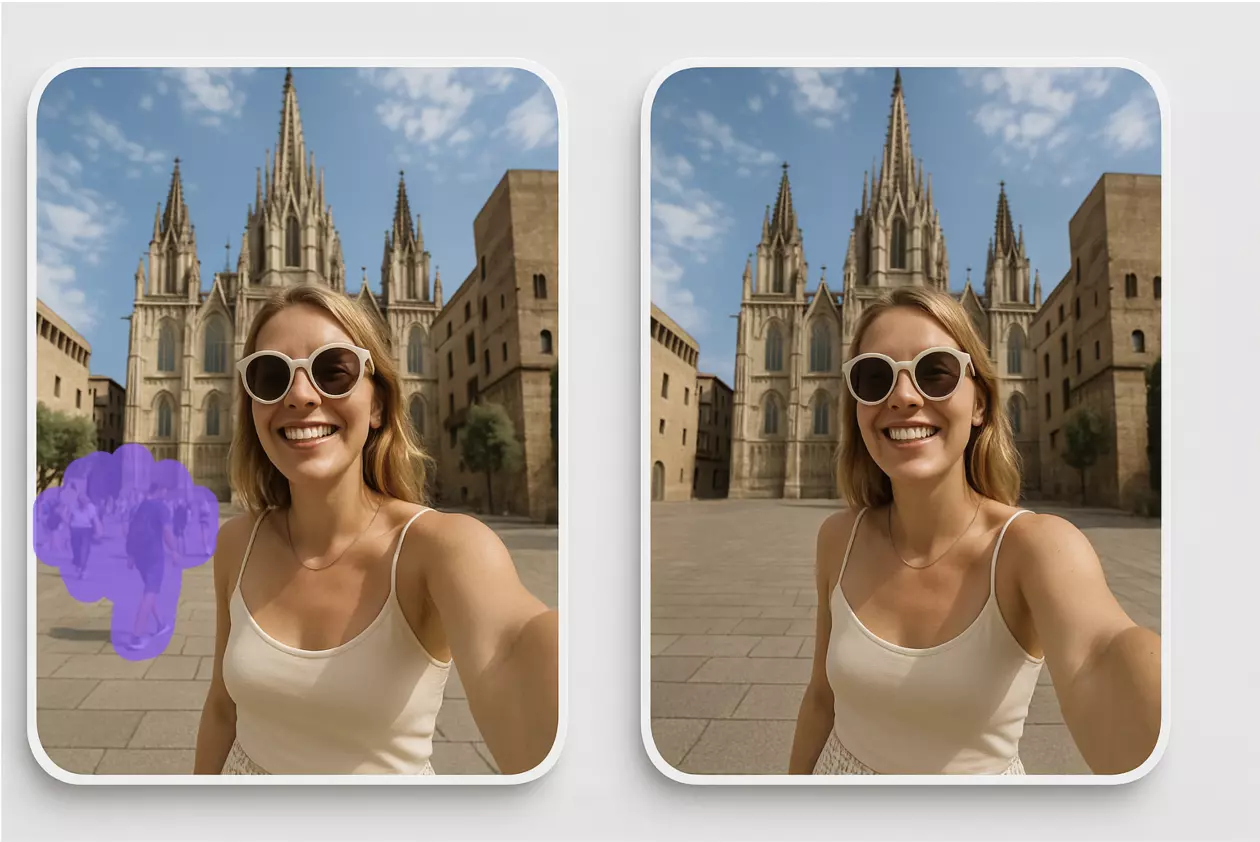
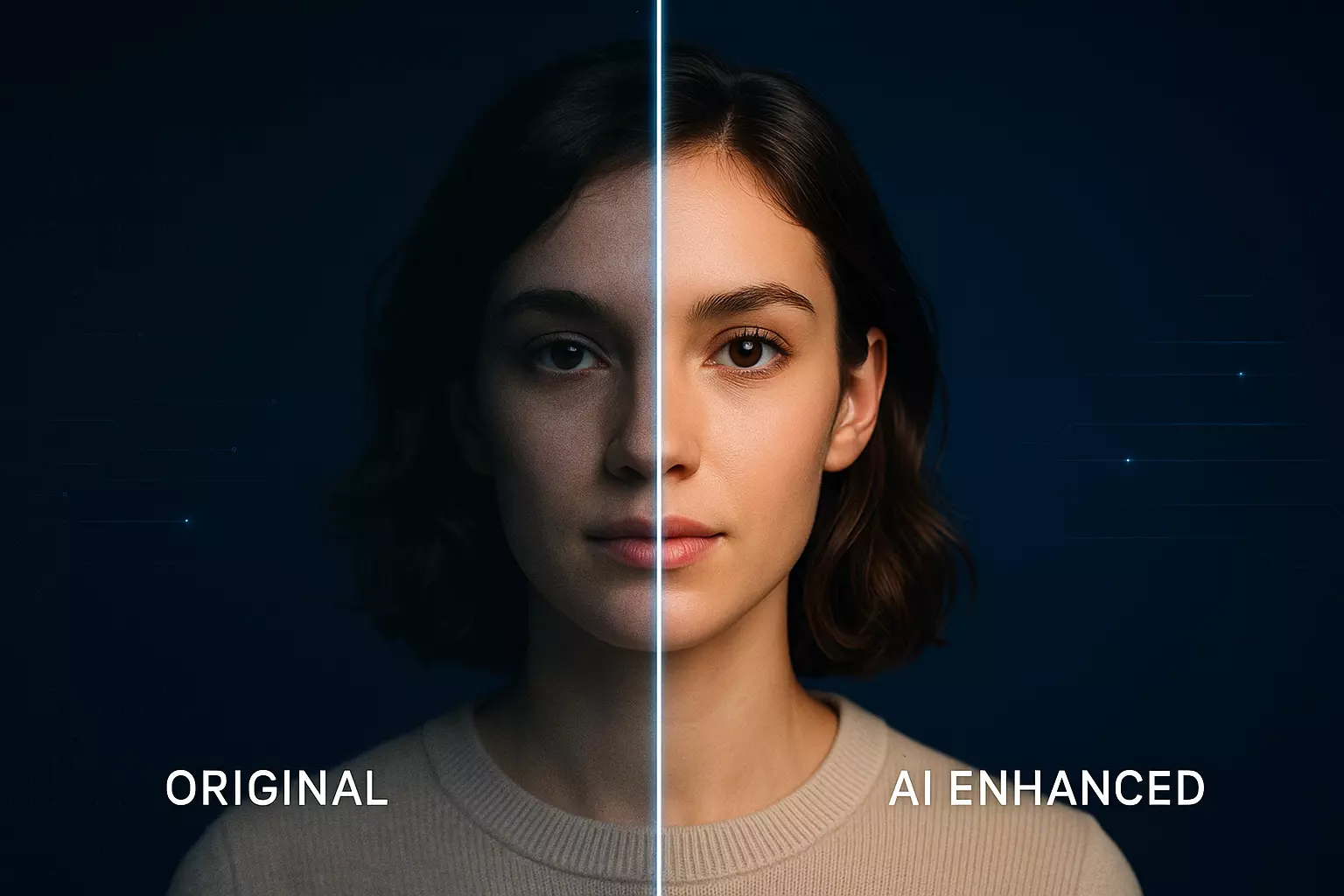
- Online AI remover such as Pixflux.AI: Best for speed, ease, and consistency across many images. Pixflux.AI can remove captions, logos, or watermarks with smart inpainting, and you can also enhance sharpness or remove stray objects to tidy a slide hero image.
- Hybrid flow: Use an online tool for bulk cleanup, then do targeted polish in your desktop editor before exporting.
How to remove text from image with AI inpainting
Follow this short, repeatable workflow to get natural, artifact-free results:
1) Isolate the problem area
- Identify whether text overlaps simple backgrounds (solid colors, soft gradients) or complex textures (fabric, metal, wood). This informs your brush size and tolerance.
2) Inpaint conservatively
- Mask slightly beyond the text edge to give the model room to reconstruct borders and micro-texture. For complex textures, work in smaller passes.
3) Match lighting and grain
- After the inpaint, compare luminance and noise with surrounding areas at 100% zoom. If the fill looks too smooth, add a subtle grain layer or use an “enhance details” adjustment.
4) Check edges at 200–400%
- Look for halos, ghost characters, or banding on gradients. If you see repeating patterns, re-run a smaller mask or rotate the mask selection to vary the prediction.
5) Validate on a slide canvas
- Drop the edited image onto your slide master to confirm it holds up under typical zoom levels and background colors.
Remove captions, logos, or watermarks in three steps with Pixflux.AI
For a simple, fast path, try Pixflux.AI’s inpainting flow. You can remove text in image and preview results instantly:
1) Upload your image
- Open the Pixflux.AI tool page and add the photo or screenshot that has unwanted text.
2) Let the AI handle removal
- Select the text area. The AI reconstructs clean pixels that match adjacent edges, textures, and color.
3) Download your cleaned image
- Preview the result, make minor tweaks if needed, then download a high-quality file for your slides.
Tip: If your slide hero also has a distracting object (unwanted signage, cables, passerby), remove it in the same pass. You can also lightly enhance clarity to ensure the cleaned region matches image detail across the frame.
(See image: a three-step Pixflux.AI interface sequence—upload, process removal, preview and download.)
Manual techniques when you need precision
- Clone Stamp: Sample from a nearby clean area and paint over the text. Match brush hardness to the edge softness of the background. Great for straight edges or repetitive patterns you can control.
- Healing Brush: Blends sampled texture with underlying tone and color—ideal for skin or soft surfaces.
- Content-Aware Fill: Quickly fills larger areas by analyzing surrounding pixels. Use it as a first pass, then refine with Clone/Heal.
- Edge-first strategy: Protect geometric elements (UI borders, boxes, shelves) by restoring edges first, then filling interior zones.
(See image: close-up screenshot of clone and healing strokes rebuilding textured backgrounds after text removal.)
Quality checklist for artifact-free cleanup
Run through this quick list before you export:
- Edge continuity: No kinks or wobble where lines continue beneath removed text.
- Texture fidelity: Wood grain, fabric weave, or noise pattern remains consistent; no “plastic” patches.
- Lighting and shading: Reconstructed areas follow the scene’s direction of light and shadow.
- Color harmony: No color cast boundaries. Check gradients for banding.
- Grain and sharpness: Match the camera noise level; apply a subtle grain overlay if the fill is too smooth.
- Compression safety: Save a lossless master (PNG or high-quality JPEG) before your final export for slides.
Case study snapshot: before–after and measurable quality
In an internal demo with a product photo that had a bold overlay:
- The AI inpaint removed the caption in under 5 seconds.
- Visual checks showed continuous edges across a wooden tabletop and preserved bokeh in the background.
- Quantitative pass: SSIM compared to a text-free reference exceeded 0.96, and edge continuity metrics across restored boundaries were consistent with adjacent regions.
(See image: before-and-after comparison of the same product photo with a text overlay removed using the Pixflux.AI watermark remover.)
Note: Your results may vary by texture complexity and image compression. Always inspect at 100–200% zoom and on your actual presentation canvas.
Troubleshooting common issues
- Ghosting (faint text outlines): Expand your mask a few pixels beyond the text boundary and re-run. Add micro-grain to blend.
- Banding in gradients: Re-run the fill with a larger feather or apply a light dithering/noise pass to break up banding.
- Repeating patterns (“tile” look): Inpaint in smaller segments, changing the sampling neighborhood each time.
- Color casts: Use selective color or curves to nudge the filled region toward the scene’s average hue.
- Sharp edges near UI: Restore edges first using a small, hard brush or vector line, then fill interior areas.
Ethics and copyright: watermark removal the right way
Only remove watermarks, logos, or text from images you own or are licensed to modify. Do not use text removal to bypass licensing, attribution, or platform rules. When in doubt, seek permission from the rights holder, or source an alternative image that fits your use case.
Batch processing for slide libraries and templates
When you need to clean dozens of images for a quarterly review or conference deck, speed and consistency matter:
- Batch-first approach: Use an online remover like Pixflux.AI to process a set of images in one sitting so the visual quality and grain level stay consistent across slides.
- Holistic clean-up: While removing text, also tidy up small distractions (wires, stray reflections) and lightly enhance contrast so visuals read clearly in projection.
- Background alignment: If an image background fights your brand template, use AI to adjust or subtly replace it with a cleaner alternative for the hero slide, then keep the rest of the sequence consistent.
Export settings and file formats for 2025
- Resolution: For 16:9 Full HD slide decks, 1920×1080 is standard; for large LED walls or 4K recordings, prepare 3840×2160 assets.
- Format: Use PNG for graphics/flat color or text overlays; high-quality JPEG (85–95) for photos. Consider WebP for web versions, but keep slide assets in PNG/JPEG for broad compatibility.
- Color profile: sRGB for slides and most webinars. Avoid mixing profiles within the same deck.
- Compression passes: Export a master, then create slide-optimized copies. Test on your presentation device to check for compression artifacts.
AI online tools vs. traditional methods
- Time cost
- Online AI (e.g., Pixflux.AI): Seconds to minutes per image, even with complex textures.
- Traditional editors: Minutes to tens of minutes per image, depending on skill and complexity.
- Learning curve
- Online AI: Minimal. Mask and go.
- Traditional: Requires familiarity with clone/heal, masks, selections, and blending modes.
- Consistency and batch efficiency
- Online AI: Easy to repeat across a set of images to maintain uniform grain and style.
- Traditional: Consistency relies on the individual retoucher; batching is slower.
- Collaboration readiness
- Online AI: Simple for marketers, PMs, and designers to align on a quick pass before deeper design work.
- Traditional: Best suited once a designer is already engaged and has context on the full layout.
Quick Pixflux.AI 5-step pro flow (optional fine-tune)
If you want a bit more control inside Pixflux.AI, try this extended pass:
1) Open the Pixflux.AI tool page. 2) Upload the original image. 3) Select the remover, brush over the text area, and run the AI inpainting. 4) Preview at 100–200%, adjust the mask or apply a light enhancement if needed. 5) Download the cleaned file for your slide deck.
Note: Use the tool only on images you own or have permission to edit.
Put it all together: a reliable “clean visuals” routine
- Start in AI to handle most removals quickly.
- Validate quality on your slide master and fix any edge or color discrepancies.
- Export presentations with consistent resolution and color.
- For recurring templates, document your preferred grain and enhancement settings so future edits match.
If you want a streamlined starting point, use Pixflux.AI for quick inpainting and minor enhancements, then finish with manual polish when needed. It’s a practical way to reduce turnaround time while maintaining presentation-grade quality.
Conclusion and next step
Crystal-clear slides convert better—whether you’re pitching investors, onboarding customers, or presenting quarterly results. Instead of fighting overlays and watermarks, let AI do the cleanup and keep your focus on the story.
Try Pixflux.AI’s fast, presentation-ready workflow to erase text from photos today. You’ll get clean imagery without sacrificing detail—and you’ll reclaim hours in your deck-building week.
(Compliance reminder: Always ensure you have the right to edit and use the images you process.)