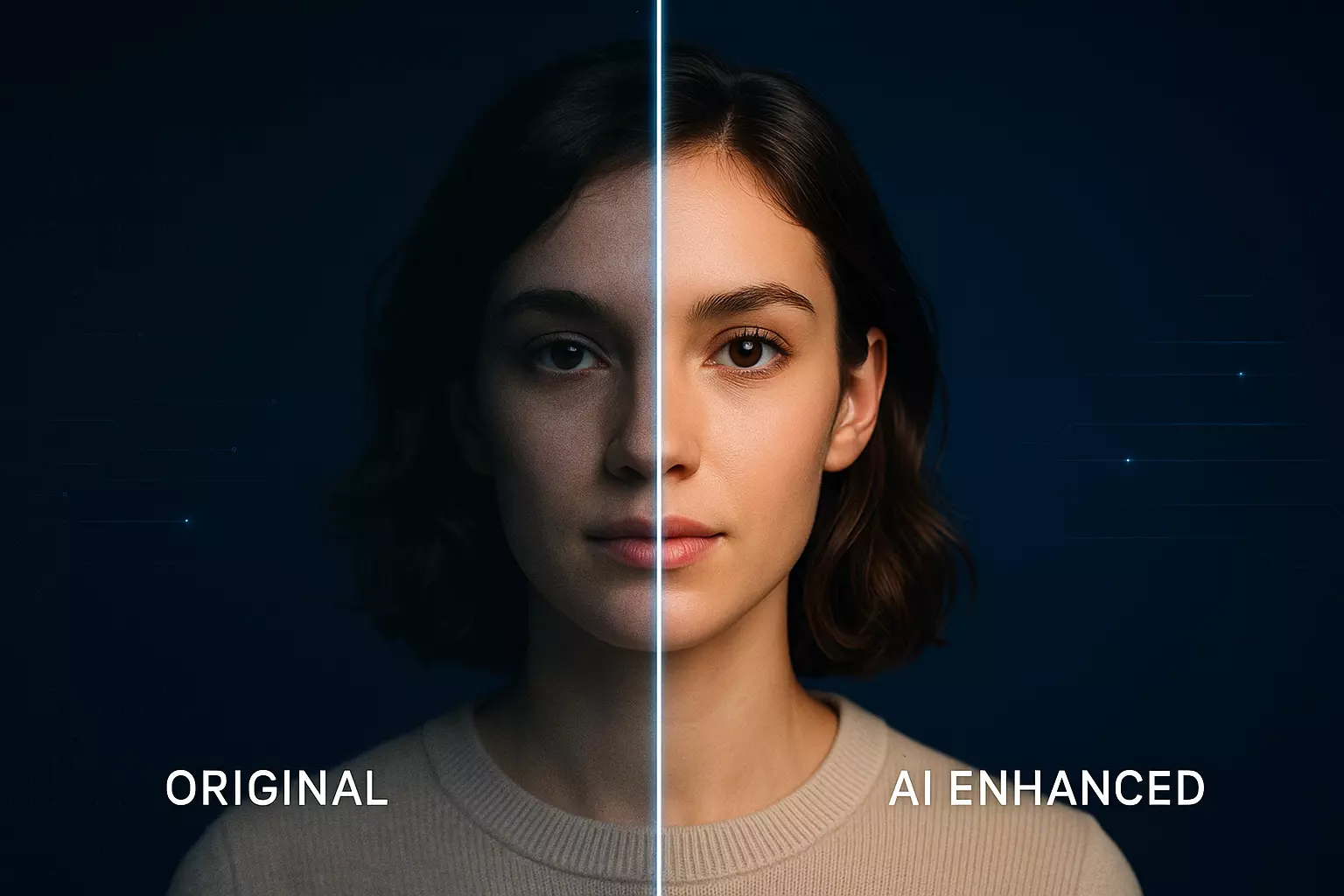
Auto Enhance Photo for Conversion: Fix Lighting and Sharpness on Product Images
Rescue dim supplier shots and make thumbnails pop. See how to fix lighting, reduce noise, and sharpen product images fast with Pixflux.AI.
 Richard SullivanJanuary 26, 2026
Auto Enhance Photo for Conversion: Fix Lighting and Sharpness on Product Images
Dim supplier images, low-contrast textures, and fuzzy edges are silent conversion killers. On mobile, where most shoppers scroll fast and judge products by tiny thumbnails, your image clarity needs to work harder than your copy. If your catalog pulls from varied vendors, you’ve likely got a mix of exposures, color casts, and noise that makes even great products feel “cheap” or unreliable.
The fix doesn’t require a photography studio or a retouching team. Modern AI tools can auto enhance photo quality in seconds—lifting exposure, reducing noise, and sharpening edges so thumbnails pop and PDP images look trustworthy. If you’re looking to make a measurable impact on CTR and conversion without rebuilding your entire workflow, start by focusing on consistent lighting and crispness. A practical first step is to auto enhance photo for the bulk of your catalog, then fine-tune a handful of hero images if needed.
Retailers across the US and globally are standardizing supplier visuals at scale using AI. With mobile-first shopping shaping behavior, bright, crisp thumbnails outperform flat, noisy ones. In this guide, we’ll cover the image enhancement fundamentals that drive conversion, when to auto enhance vs. manually retouch, and a hands-on, three-step workflow in Pixflux.AI to quickly improve product photos.
Why auto enhancement is a conversion lever
Thumbnails drive product discovery. Clearer, brighter thumbnails increase click-through rates because shoppers can recognize details faster. On PDPs, good lighting and clean edges reduce cognitive friction. Customers aren’t trying to decode your picture; they’re evaluating the product.
Auto enhancement works because it fixes the most common issues automatically:
- Underexposed images make colors and textures dull; auto exposure correction adds perceived contrast.
- High ISO noise from supplier shots reduces clarity; denoise brings back smooth gradients.
- Soft edges make products feel low quality; smart sharpening improves perceived detail without harsh halos.
- Color casts (e.g., cool fluorescent or warm tungsten) distort brand colors; automatic balance restores fidelity.
When repeated across an entire catalog, these incremental improvements add up—especially for marketplaces like Amazon or fast social commerce formats like TikTok Shop, where images compete in crowded grids.
Enhancement fundamentals: exposure, contrast, sharpness, noise, color
Treat enhancement like an ordered checklist. The right sequence prevents overcorrection and keeps the product feeling true-to-life.
1) Exposure and contrast
- Lift exposure until the product looks bright but not washed out.
- Protect highlights so white packaging doesn’t clip to pure white.
- Add gentle contrast to define shape and edges, especially for matte surfaces.
2) White balance and color casts
- Neutralize color casts before anything else. Whites should look white.
- Maintain brand colors—especially for fashion or cosmetics. Use a known swatch or style guide as your reference.
3) Noise reduction (denoise)
- Remove sensor noise and JPEG artifacts to smooth flat areas (backgrounds, shadows).
- Aim for a clean but natural look. Over-denoise can plasticize textures.
4) Sharpening and micro-contrast
- Sharpen last, after denoise, to avoid amplifying noise.
- Use modest radius and amount to enhance edges without halos.
- Check at 100% zoom; if you see crunchy outlines, dial it back.
5) Background consistency
- A consistent background across your catalog (clean white, soft gray, or branded context) reduces visual clutter.
- If needed, replace or clean up the background for thumbnails to standardize appearance.
(See image reference: a before-and-after grid of a dim supplier product photo—left shows underexposure and noise; right shows improved lighting, reduced noise, and sharper edges that stand out in ecommerce thumbnails.)
When to auto enhance vs. manual retouch—and when to batch
Use auto enhance for 70–90% of your catalog. It’s the fastest path to consistency and is especially effective for:
- Supplier images that are a bit dark, slightly noisy, or flat.
- Thumbnails that need quick punch and clarity.
- PDP images requiring basic cleanup rather than complex compositing.
Use manual retouch for exceptions:
- High-stakes hero banners where precise color grading and reflection control matter.
- Complex defects (heavy glare on glossy packaging, distorted labels).
- Creative campaigns where artistic intent overrides standardization.
Batch processing is ideal when:
- You onboard many SKUs from a supplier and want consistent exposure and sharpness.
- You need to remove simple, recurring distractions (e.g., small scuffs, faint watermarks) and standardize backgrounds for product tiles.
Note on compliance: Only remove watermarks or logos if you own the rights or have explicit permission. Respect licensing and platform policies.
Online tools vs. desktop editors and outsourcing
Choosing how to enhance your images depends on speed, control, and consistency.
- Time to value
- Online AI tools: Minutes to results; processing happens right after upload.
- Desktop editors (e.g., traditional pro software): Powerful, but slower for bulk tasks.
- Outsourcing: Slowest feedback cycle; good for complex briefs but not fast iteration.
- Learning curve
- Online AI tools: Low. Sliders and one-click fixes handle >80% of needs.
- Desktop editors: Steeper learning, especially for color management and masking.
- Outsourcing: Minimal in-tool learning, but requires briefs, QA, and back-and-forth.
- Batch processing and consistency
- Online AI tools: Batch-friendly and consistent across sets, crucial for catalog launches.
- Desktop: Batch actions possible, but setup is manual and brittle across diverse images.
- Outsourcing: Consistency depends on vendor QA and style guides.
- Collaboration and speed of iteration
- Online AI tools: Easy for cross-functional teams to preview, comment, and re-export aligned versions without heavy files.
- Desktop: File versioning and local profiles can slow handoff.
- Outsourcing: Iterations require rounds and add lead time.
If your goal is to raise baseline quality across a catalog quickly and repeatably, an online workflow is hard to beat.
Hands-on: Enhance images fast with Pixflux.AI
Pixflux.AI accelerates the basics—fixing lighting, reducing noise, and sharpening—so you can publish more consistent product photos, sooner. Here’s the three-step flow:
1) Upload your original product image Drag-and-drop your supplier photo or select it from your computer.
2) Let the AI process the image Pixflux.AI automatically analyzes exposure, noise, and edge definition, then enhances the image for clarity. You can automatically enhance photos in batches to keep a whole collection consistent.
3) Preview and download the result Review the enhanced version, make small tweaks if offered, and download the final image for your PDP or thumbnail.
(See image reference: the Pixflux.AI interface with the three-step flow—upload image, AI processing preview, and download enhanced result.)
Pro tip: If your catalog has distractions like stray cables or scuffs, use the object removal tool to clean up the frame. For images sourced from partners, remove watermarks only when you own the rights or have explicit permission.
A practical workflow to improve quality of photo for thumbnails and PDPs
Use this repeatable sequence when preparing product images:
- Start with exposure and white balance Aim for bright but controlled highlights. Neutral whites avoid color surprises on PDPs.
- Reduce noise before sharpening Denoise smooths shadows and backgrounds; sharpening after denoise recovers crisp edges without accentuating grain.
- Sharpen for detail, but avoid halos Moderate settings keep edges clean. Always check at 100% zoom.
- Standardize backgrounds for thumbnails If your marketplace requires white or light gray, switch backgrounds to match guidelines. For lifestyle PDPs, generate a clean, brand-aligned background that doesn’t compete with the product.
- Remove distractions Clear dust, small props, or passerby reflections that dilute focus on the SKU. This matters on glossy packaging and reflective surfaces.
- Address watermarks and labels judiciously If you legally can, remove watermarks for a clean, catalog-ready look. Keep a changelog of source image permissions to comply with marketplace audits.
- Resize and export For thumbnails, aim for ~600–800 px on the long edge. For PDPs, ~1500–2500 px balances detail and load time. Apply sensible compression to avoid artifacts while keeping pages fast.
- Test and iterate A/B test thumbnail variants on mobile. Often, a slightly brighter, cleaner version wins. Track CTR and add-to-cart to prove impact.
(See image reference: side-by-side in Pixflux.AI showing the same product image with background removed and watermark removed—demonstrating catalog-ready consistency.)
Advanced Pixflux.AI workflow (optional, 5 steps): 1) Open Pixflux.AI 2) Upload a batch of supplier images 3) Choose the enhancement tool to fix lighting, reduce noise, and sharpen 4) Preview results and apply minor adjustments for the outliers 5) Download the processed set and publish
Real-world scenarios where Pixflux.AI helps
- Marketplace onboarding: You get a mixed bag of product shots from a new vendor. Use Pixflux.AI to denoise, brighten, and sharpen the set so the grid looks unified.
- Social promos: For a flash sale, quickly enhance a subset of images for mobile-first placements—clean backgrounds and crisp edges make text overlays more legible.
- Catalog refresh: Quarterly, re-export PDPs at the ideal size after enhancement to keep performance and consistency high.
Retail teams increasingly rely on AI enhancement to shorten catalog launch cycles. With fast batch processing and consistent backgrounds, you can push updates without re-shoots—keeping seasonal drops on schedule.
FAQ: Auto enhancement, image quality, and ecommerce standards
What is the difference between auto enhance photo and enhance image?
They’re functionally similar; auto enhance runs preset adjustments, while enhance image can include manual fine-tuning. Auto enhancement applies intelligent defaults to exposure, contrast, noise, and sharpness. Enhance image often implies you’ll review and tweak per photo (e.g., adjusting white balance or sharpening strength). For catalogs, start with auto enhancement, then fine-tune hero shots if needed.
How do I improve quality of photo without over-sharpening?
Denoise first, then apply modest sharpening and review at 100% to avoid halos. Noise reduction removes grain that sharpening would otherwise exaggerate. Use small radius and conservative amounts; edges should look crisp but not crunchy. If you notice bright outlines or ringing, reduce the amount and consider a touch more denoise.
Will auto enhancement shift brand colors?
Lock white balance and constrain saturation, then compare to a reference swatch. Auto enhancement can lift saturation and contrast slightly. To protect brand fidelity, set white balance early and limit global saturation boosts. Compare the result to your style guide or a physical swatch, especially for brand-critical colors.
Can I batch enhance supplier photos for speed?
Yes—batch enhancement applies consistent fixes across many images at once. In Pixflux.AI, you can process multiple files together, ensuring uniform exposure and sharpness across a collection. This is ideal when onboarding large catalogs or refreshing PDPs ahead of campaigns.
Is it okay to remove watermarks from product shots?
Only if you own the rights or have explicit permission. Watermark removal should never be used to bypass licensing or platform rules. Keep documentation of permissions from vendors and partners, and follow marketplace guidelines to avoid compliance issues.
What output resolution should I use after enhancement?
Use ~600–800 px long edge for thumbnails and ~1500–2500 px for PDP images. This range preserves detail for zoom while keeping pages fast. Apply sensible compression to avoid visible artifacts. Always check your platform’s specific requirements (e.g., Amazon’s minimums) and test on mobile.
Do auto enhancement tools work across all product types?
Yes for most SKUs, but reflective or transparent items may need light manual tweaks. Glass, chrome, and clear plastics can reveal glare and edge ambiguity. Start with auto enhancement, then adjust highlights or edges manually if reflections distract from the product shape.
Is my data safe when using online photo enhancers?
Use reputable tools and follow your company’s data policies when uploading images. Avoid uploading confidential prototypes if your policy forbids it. For published product shots, standard enhancement uploads are typical. Review the tool’s privacy documentation and restrict access to authorized team members.
Measurable impact: where auto enhancement shows results
- Thumbnail CTR: Brighter, crisper images increase recognition and perceived quality in crowded grids, especially on mobile.
- PDP trust: Reduced noise and accurate color make materials and finishes feel true-to-life, supporting conversion and reducing returns.
- Operational speed: Batch enhancement and consistent backgrounds shorten launch cycles without reshoots.
If you’re starting from varied supplier imagery, the fastest path to improvement is running a catalog pass that focuses on exposure, noise, and sharpness. You can do this in minutes and measure the lift on your next campaign.
Get started
Clean, consistent product images are a conversion advantage you can control. Try Pixflux.AI to denoise, brighten, and sharpen your next batch of supplier photos—then publish with confidence. Jump in now to automatically enhance photos for your thumbnails and PDPs, or bookmark it as your daily catalog prep step.
Want a single link to remember? Save this page and come back whenever you need fast auto photo enhancement that keeps your catalog looking sharp and on-brand.